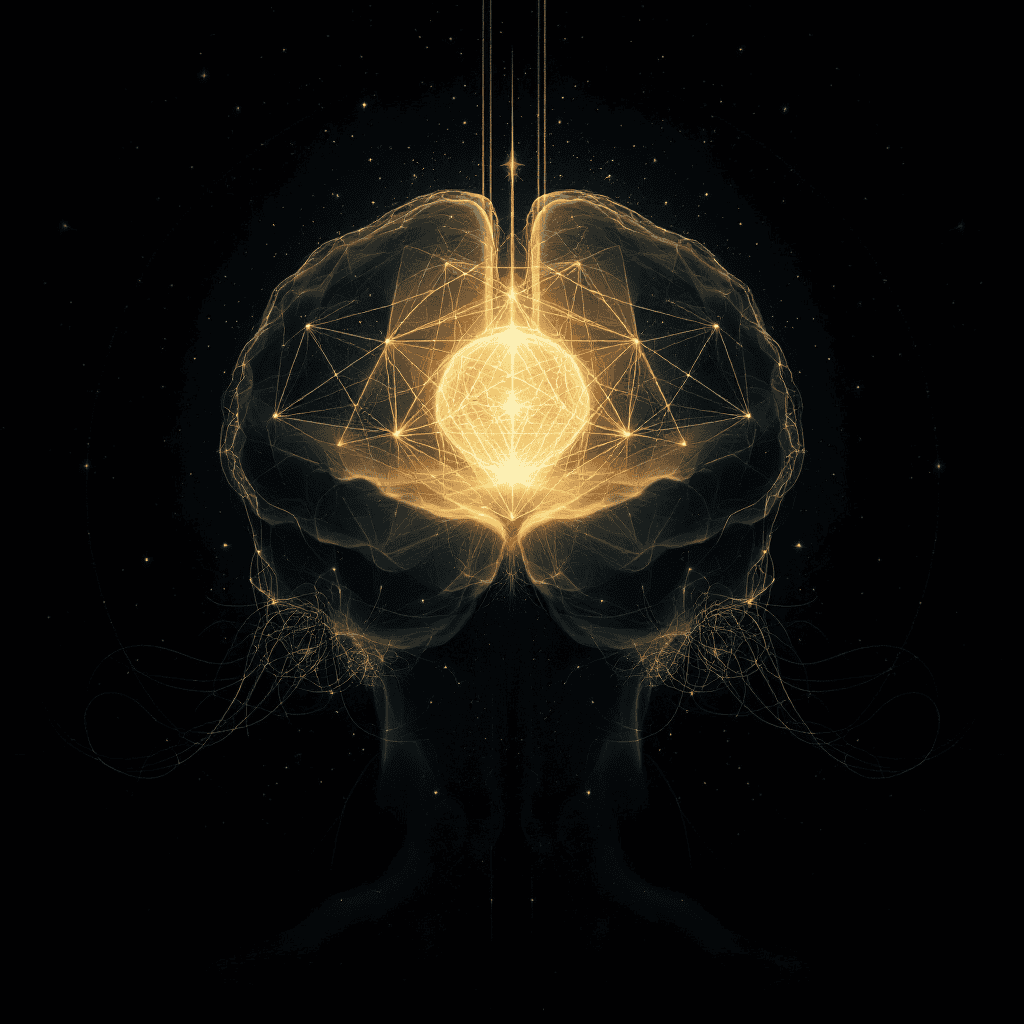
Christos oil and the claustrum form one of the most precise and overlooked connections in the study of inner anointing. The claustrum is a wafer-thin sheet of neural tissue hidden deep within the brain, so concealed that neuroscience largely ignored it for decades. Yet this tiny structure may be the biological origin point of what ancient traditions called the sacred secretion, the Christos oil that descends through the spine and, when preserved through discipline, rises again to illuminate consciousness.
The claustrum sits between the insula and the putamen, threading connections to nearly every region of the cortex simultaneously. It is the brain’s most globally connected structure, wiring sensory, emotional, motor, and cognitive areas into a unified field. Francis Crick, co-discoverer of the DNA double helix, proposed shortly before his death that the claustrum might be the seat of consciousness itself, the conductor integrating sight, sound, touch, and thought into a single coherent experience. Remove its input and awareness fragments. Restore it and coherence returns.
What makes this structure even more remarkable is its name. Claustrum comes from the Latin claudere, meaning to shut or enclose, the same root as cloister. It is literally a hidden, enclosed chamber inside the skull. When Jesus instructed, “Enter your closet and shut the door” (Matthew 6:6), the ancient initiates may have understood this not as a room in a house, but as this precise anatomical location. The closet is the claustrum. The door is the discipline required to activate it. And what happens inside that chamber is where the Christos oil begins its sacred journey.
The Claustrum as the Holy of Holies
The claustrum occupies the same symbolic position in the brain that the Holy of Holies occupied in Solomon’s Temple: the innermost chamber, hidden behind layers of protection, accessible only through purification. In Jewish tradition, only the High Priest could enter the Holy of Holies, and only once per year on Yom Kippur, after extensive fasting and ritual cleansing. The biological parallel is exact. The claustrum cannot be accessed through external effort or force. It activates when the nervous system is calm, the ego is quiet, and the body-temple is purified.
This chamber interfaces directly with the thalamus and hypothalamus, which regulate the pituitary and pineal glands. The pineal is the lamp of the body, governing light cycles, melatonin production, and inner vision. The pituitary is the master regulatory gland, orchestrating growth, hormones, and systemic balance. The claustrum is what sets both in motion, the switchboard determining whether the sacred secretion activates or remains dormant. When thought, feeling, and emotion align in coherence, the claustrum signals the pineal and pituitary to release their secretions. This is the conception of the Christos oil.
Modern brain imaging confirms what the ancients encoded in ritual. The claustrum sends and receives signals across sensory, emotional, and cognitive networks simultaneously. In one documented case, direct electrical stimulation of the claustrum switched off a patient’s awareness entirely while leaving all other brain functions intact. When the stimulation stopped, awareness returned. A single structure, acting as an on/off switch for conscious experience. This is not metaphor. This is physiology. And it is where the oil of anointing originates.
How the Sacred Secretion Begins
The Christos oil is produced when the pineal and pituitary glands release their secretions in coordinated rhythm. The pineal produces a golden, luminous fluid associated with melatonin and potentially other compounds involved in altered states of consciousness. The pituitary produces a milky secretion of oxytocin, vasopressin, and growth-related hormones. Together, these form what scripture called “the land flowing with milk and honey.” The claustrum is the conductor that signals this release.
This secretion descends into the cerebrospinal fluid, the river of life that bathes the brain and spinal cord. From there it travels down the spine, carried along the central channel that yogic traditions call the sushumna and Kabbalistic maps call the middle pillar. If the vessel is purified through fasting, breath, and the forsaking of ego-driven appetite, the oil is preserved. If scattered through indulgence, distraction, or chronic stress, it dissipates before it can rise. The journey from conception in the claustrum to ascension at the crown depends entirely on the discipline of the seeker.
The ancient traditions preserved this process through ritual because they lacked the language to describe it biologically. But the map was always anatomical. The claustrum was the closet. The cerebrospinal fluid was the Jordan River. The spinal column was Jacob’s Ladder. And the oil rising through the 33 vertebrae was the resurrection of Christ consciousness within the human temple.Understanding the biological mechanics of this inner anointing doesn’t reduce the sacred. It reveals how the sacred was written into the body itself.
The Claustrum and the Activation of Da’at
In Kabbalistic mysticism, Da’at is the hidden sephirah, the gate of knowledge that sits between wisdom and understanding, between the upper and lower realms of the Tree of Life. It is not counted among the ten sefirot because it is not a fixed station but a threshold, a point of convergence that ignites only when the polarities of the Tree are balanced. The claustrum is the biological expression of Da’at. It is the hidden chamber where thought, feeling, and emotion must converge before the oil can rise.
Da’at opens when the pineal (intuitive reception, the feminine pole) and the pituitary (analytical regulation, the masculine pole) harmonize through the heart. The heart generates the body’s most powerful electromagnetic field, a toroidal current that extends several feet beyond the skin. When heart rhythm becomes coherent through gratitude, compassion, or sustained presence, that field stabilizes. The nervous system shifts from sympathetic overdrive into parasympathetic calm. The claustrum registers this shift and signals the pineal and pituitary to release their secretions in unison. This is the ignition of Da’at. This is the moment the Christos oil is conceived.
The traditions that preserved this knowledge encoded it in symbol because the physiology was hidden. But the instructions were always precise. Fast to quiet the digestive system. Breathe to regulate the nervous system. Surrender ego to stabilize the heart field. When these conditions align, the claustrum activates naturally. The oil descends, and if preserved, it rises again to illuminate the single eye. The mystics called it gnosis. Neuroscience calls it global integration. Both describe the same event: the moment when fragmented perception unifies into coherent awareness.
The Role of Cerebrospinal Fluid
The Christos oil does not travel through the bloodstream. It moves through cerebrospinal fluid, the clear liquid that cushions the brain and spinal cord. CSF is not passive. It carries neuropeptides, growth factors, hormones, and neurotransmitter precursors that directly shape brain function, mood, and perception. The glymphatic system, discovered in 2012, shows that CSF actively flushes metabolic waste and supports brain renewal during sleep and fasting. The sacred secretion pathway, from the brain’s ventricles through the spinal column and back to the crown, is verifiable in any medical textbook. What the ancients called the oil is what science calls CSF carrying hormonal signals through the body’s central axis.
The CSF pathway flows through the third ventricle, the chamber that sits between the two thalamic bodies, and bathes the pineal and pituitary glands continuously. These are the structures that regulate consciousness, sleep cycles, hormonal rhythms, immune response, and perception. The ancients called them Mary and Joseph, the feminine and masculine poles that conceive the sacred seed. Modern endocrinology describes them as the neuroendocrine command center. Same chamber. Same function. Different century.
When the claustrum signals and the pineal and pituitary respond, their secretions enter the CSF and begin the descent. The oil moves down the spine, through the central channel, past the chakras that correspond to the endocrine glands at each level: thyroid at the throat, thymus at the heart, pancreas at the solar plexus, adrenals at the root. If the seeker preserves the current through discipline, breath, and sexual restraint, the oil completes its circuit and ascends back to the crown. At the optic chiasm, the X-shaped crossing of the optic nerves, the oil is “crucified,” held in tension and amplified before rising into the thalamus for three days of stillness. Then, aligned with the body’s lunar rhythm, the pineal ignites. This is the resurrection. This is the moment the full mechanism of inner anointing completes its cycle.
Purification and the Claustrum’s Responsiveness
The claustrum does not activate on command. It responds to conditions. When the body is flooded with stress hormones, inflammatory signals, or the chemical residue of processed food, the claustrum’s signaling becomes erratic. Coherence collapses. The pineal calcifies under fluoride exposure. The pituitary’s rhythms scatter under chronic cortisol. The sacred secretion either fails to form or dissipates before it can rise. This is why every tradition that preserved the Christos path insisted on purification before activation. Not as moralism, but as biology.
Fasting withdraws fuel from the lower drives and allows the nervous system to reset. Autophagy, the body’s cellular recycling process, activates between 24 and 72 hours into a fast, clearing damaged proteins and accumulated toxins. The blood-brain barrier, which governs what crosses from the bloodstream into neural tissue, regains integrity when inflammation drops. The CSF itself becomes clearer, carrying signals more efficiently through the ventricles and spinal column. These are not metaphors. These are measurable physiological shifts that create the conditions under which the claustrum can signal the pineal and pituitary to release the oil.
Sexual restraint serves the same function. Around 24 to 48 hours into a fast, testosterone in men drops measurably as the body redirects resources away from reproduction and toward cellular repair. For women the mechanism runs through luteinizing hormone and follicle-stimulating hormone suppression, but the redirection is identical. The body is already performing an endocrine fast, already choosing to withdraw energy from the reproductive drive. Sexual activity during this window works directly against that process. The hormonal crash of release undoes the redirection the body just initiated. What the body takes in and what it preserves determines whether the oil can rise or whether it scatters before reaching the crown.
The Claustrum and Consciousness Integration
Recent neuroscience has begun to map what the mystics preserved in ritual. The claustrum’s connections are not random. It links to the prefrontal cortex (decision-making and focus), the anterior cingulate (conflict monitoring and moral judgment), the insula (interoception and empathy), the amygdala (emotional processing), and the sensory cortices (sight, sound, touch). No other structure in the brain wires these domains together so comprehensively. When the claustrum is active and coherent, perception unifies. When it is disrupted, awareness fragments into competing streams that never integrate.
This is why meditation, breathwork, and fasting all produce similar effects on consciousness. They quiet the noise that prevents the claustrum from integrating the system. The default mode network, the brain’s autopilot that runs when you are lost in thought, quiets. The sympathetic nervous system, which governs fight-or-flight, downregulates. The parasympathetic nervous system, which governs rest and repair, takes over. In this state, the claustrum can coordinate the brain’s networks into a single coherent field. What the mystics called the single eye, neuroscience calls global workspace integration. Both describe the moment when the inner light turns on.
The Christos oil is not the only factor in this process, but it is the biological substrate that makes sustained illumination possible. The pineal releases compounds that alter perception. The pituitary releases hormones that stabilize mood and growth. The heart generates the electromagnetic field that keeps the whole system coherent. And the claustrum conducts it all, signaling when to release, when to rise, and when to open the crown. This is the architecture of resurrection. Not a future event, but a present process encoded in the body and waiting for the discipline required to activate it.
The Hidden Chamber in Scripture and Tradition
Every tradition that preserved the inner path described a hidden chamber where the divine presence dwells. In Judaism it was the Holy of Holies, entered only by the High Priest after fasting and purification. In Christianity it was the closet where prayer is offered in secret. In Hermeticism it was the inner sanctum of the temple, the place where the alchemical work begins. In Sufism it was the heart’s inner chamber, the throne where God speaks directly to the soul. These are not separate teachings. They are different languages describing the same biological reality: the claustrum as the origin point of the sacred secretion.
The Egyptian mystery schools encoded this in the Eye of Horus. When the Eye of Horus is overlaid on a sagittal cross-section of the brain, the symbol aligns with anatomical precision to the thalamus, pineal gland, corpus callosum, and pituitary. The curved inner teardrop maps directly over the claustrum. The ancients were not guessing. They were encoding what they observed through inner vision into a symbol durable enough to survive millennia. The Eye of Horus was not decoration. It was a schematic of the brain’s spiritual anatomy, showing initiates exactly where the oil originates and where it must rise.
India’s yogic tradition preserved it as the ajna chakra, the third eye center between the brows where intuition and insight converge. The ajna corresponds to the pineal-pituitary complex, but its activation depends on the lower centers being purified and balanced. The claustrum is the gatekeeper. If the heart is incoherent, if the solar plexus is tight with fear, if the root is flooded with survival anxiety, the claustrum cannot signal coherently. The oil will not form. The third eye remains closed. The geometry of inner vision depends on the biology of inner coherence, and both depend on the claustrum functioning as the conductor of the whole system.
Scientific Validation and the Future of Research
The claustrum’s role in consciousness remains one of neuroscience’s open questions, but the evidence is mounting. Studies using functional MRI and electrical stimulation have shown that the claustrum modulates awareness, attention, and sensory integration in real time. Its connections to nearly every cortical region suggest it operates as a global coordinator, exactly as Crick proposed. What remains unexplored is its connection to the endocrine system, particularly the pineal and pituitary glands, and whether the secretions these glands produce under specific conditions correlate with the altered states mystics have described for millennia.
The pineal’s role in producing melatonin is well established. Its potential role in producing DMT, the compound associated with mystical visions and near-death experiences, remains unconfirmed in humans but is supported by animal studies. The pituitary’s role in releasing oxytocin, the hormone of bonding and trust, and vasopressin, which regulates water balance and social memory, is documented. What has not been studied is whether these secretions, when released in coordinated rhythm during fasting and meditation, produce the neuropeptide signature that ancient traditions called the Christos oil. The research tools exist. The question is whether institutional science will ask the question.
The traditions that preserved this knowledge did not wait for laboratory confirmation. They tested it experientially, refined the protocols over generations, and encoded the results in myth, ritual, and architecture so the knowledge would survive. The claustrum was the closet. The CSF was the Jordan. The spine was the ladder. And the oil rising through the 33 vertebrae was the biological resurrection that every seeker was invited to embody. The science is catching up to what the mystics always knew: the body is the temple, and the claustrum is where the anointing begins.
Practical Implications for the Modern Seeker
Understanding the connection between Christos oil and the claustrum is not academic. It is operational. If the claustrum is the origin point of the sacred secretion, then the conditions that activate it become the central focus of spiritual practice. Fasting clears the noise. Breathwork regulates the nervous system. Heart coherence stabilizes the field. Sexual restraint preserves the current. Silence allows the claustrum to integrate what the outer world fragments. These are not separate practices. They are the coordinated preparation of the vessel so the claustrum can signal, the pineal and pituitary can respond, and the oil can begin its descent.
The modern environment works against this process at every level. Artificial light disrupts the pineal’s circadian rhythm. Processed food inflames the blood-brain barrier. Chronic stress floods the system with cortisol. Digital overstimulation scatters attention and prevents the claustrum from achieving the quiet coherence it requires to function. Pornography, social media, and compulsive consumption all drain the generative energy the oil depends on. The path forward is not complex, but it is total. Discipline the body. Quiet the mind. Stabilize the heart. Forsake the appetites that scatter the current. When these conditions align, the claustrum activates naturally, and the oil begins its sacred journey.
The traditions encoded this in ritual because ritual survives when understanding is lost. Yom Kippur’s 25-hour fast. Ramadan’s triple restraint. Lent’s 40 days. The Desert Fathers’ solitude. The yogic practice of brahmacharya. All are different expressions of the same biological protocol: create the conditions under which the claustrum can signal the pineal and pituitary to conceive the oil, and then preserve that oil through discipline so it can rise. The resurrection is not a future promise. It is a present process encoded in every human body and waiting for the seeker willing to walk the path.