The Claustrum
The hidden brain chamber Francis Crick called the seat of consciousness. Where the inner anointing begins.
The claustrum is a thin sheet of neurons buried deep in the brain. Francis Crick spent the last paper of his career arguing it was the seat of consciousness. Esoteric tradition called it Da'at, the hidden Sephirah. The chamber where the inner anointing oil is first produced before it descends and ascends through the spine.
What the Claustrum Is
The claustrum is one of the most mysterious structures in the human brain. A thin sheet of gray matter sandwiched between the insula and the putamen on each side of the brain. Wired to almost every other region of the cortex.
For most of medical history, the claustrum had no clear function. It sat there, dense with connections, doing something. Francis Crick (the same Crick who co-discovered DNA) spent the final years of his career arguing that this structure was the seat of consciousness. His final scientific paper, published posthumously in 2005, made the case: the chamber is the brain's conductor. The site that binds disparate sensory streams into the unified experience we call awareness.
Crick was working from neuroscience. He had no esoteric framework. But the structure he described had been described before. Kabbalah called it Da'at. The hidden Sephirah. The eleventh node on the Tree of Life that does not appear on the standard diagram because it is not a station you arrive at. It is the chamber you pass through when consciousness assembles.
Descartes, Crick, and the Seat of the Soul
The seat of the soul is one of the oldest questions in Western thought. Where in the body does consciousness live? Descartes, writing in the 1640s, picked the pineal gland. He chose it because the pineal sits unpaired at the center of the brain. One organ, not two. The single point where the spirit could meet the flesh.
Three centuries later, Francis Crick took the same question and gave a different answer. Not the pineal. The claustrum. The thin sheet of neurons whose unique connectivity made it the most plausible candidate for the binding role consciousness requires. Descartes had the location off by a few millimeters. The instinct was right. The seat of the soul sits in the cranial vault, in the chamber where signals converge into the unified experience of being a self.
The book treats both answers as half of one truth. The pineal is the receiver. The claustrum is the integrator. Together they form the inner sanctum every mystery school protected. The seat of the soul is not one organ. It is the chamber the two glands create when they lock into rhythm.
Da'at, the Hidden Sephirah
Da'at means "knowledge" in Hebrew. Not data. Direct knowing. The Sephirah that is and is not on the Tree at the same time. Kabbalists drew it sometimes, omitted it other times, depending on the teaching. Da'at sits where the claustrum sits anatomically. Between the upper triad and the lower seven. The bridge.
Two traditions, separated by a thousand years, both pointing at the same chamber. One in mystical Hebrew. One in modern neuroscience. The same brain. The same location.
The full claustrum mapping, with the Crick paper citation and the Da'at correspondence, is the opening biology of Redacted, Chapter 21.
Where the Inner Anointing Begins
The Christos path has 12 stages. The chamber is stage two. The first stage is the union of pineal and pituitary. The second is the secretion that union produces, gathered in the claustrum, before it descends to begin its journey down the spine.
The Greeks called this inner secretion Christos. The anointing oil. The same word the church externalized as chrism in a vial. The original meaning pointed to a fluid produced inside the brain, gathered in a hidden chamber, descending the spinal river, surviving the wilderness of preservation, and ascending again to ignite the pineal at the crown.
When tradition spoke of an oil descending and rising, modern readers heard metaphor. The claustrum changes the reading. There is an actual chamber. There are actual neurochemicals produced and routed through cerebrospinal fluid. The specific compounds modulated during sustained meditation are Redacted, Chapter 21. The "oil" the ancients described maps onto a real biological process the church spent fifteen centuries hiding behind ceremony.
Cerebrospinal Fluid: The Sacred River
Cerebrospinal fluid is the body's most sacred fluid. Roughly 150 milliliters of it bathe the brain and spinal cord at any moment. It is replaced about three times per day. It carries neuropeptides, hormones, growth factors, and neurotransmitter precursors that directly shape brain function and perception.
CSF flows from the brain's ventricles through the third ventricle (where the pineal sits), down the central canal of the spinal cord, and back up. It is the literal "river" Revelation 22:1 describes flowing from the throne of God. The throne is the cerebrum. The river is CSF. The sacred fluid mystics described as the carrier of the inner Christ is the same fluid neurosurgeons drain when intracranial pressure rises.
The Glymphatic System
In 2012, researchers at the University of Rochester documented a previously unknown system in the brain. They called it the glymphatic system. It uses CSF to actively flush metabolic waste from the brain during sleep. The brain self-cleans every night, using cerebrospinal fluid as the medium.
The mystics had no MRI. They had practice. They documented that prolonged fasting, breath retention, and meditation produced enhanced clarity, vision, and energy the next morning. We now know why. The glymphatic flush is amplified by every input the mystics prescribed. The specific protocol that maximizes the flush, with timing and duration, is Redacted, Chapter 22. The science caught up with the practice.
Peniel Meaning: The Place of Encounter
Genesis 32:30 names the location where Jacob "saw God face to face." He calls the place Peniel. The Hebrew is one letter from "pineal." The encoding is consistent: the inner encounter happens at a specific anatomical site near the chamber we are mapping.
Peniel meaning, in Hebrew, is "face of God." The story has Jacob wrestling all night with a stranger, refusing to let go until he receives a blessing, emerging at dawn renamed Israel and limping. The literal reading turns this into a wrestling match with an angel. The inner reading sees an all-night meditation. A breakthrough. An encounter at the chamber where the pineal sits and the binding chamber assembles awareness into unity.
"My life is preserved." Jacob limps because his hip socket is dislocated. Anatomically, the inner ascent often produces somatic effects. Heat. Pressure. Spontaneous shaking. The body marks the experience. Jacob's limp is not failure. It is the proof he made it through.
The Peniel and pineal etymology, with the full Hebrew breakdown and the cross-tradition encoding, is decoded in Redacted, Chapter 14.
The Hidden Chamber, Mapped
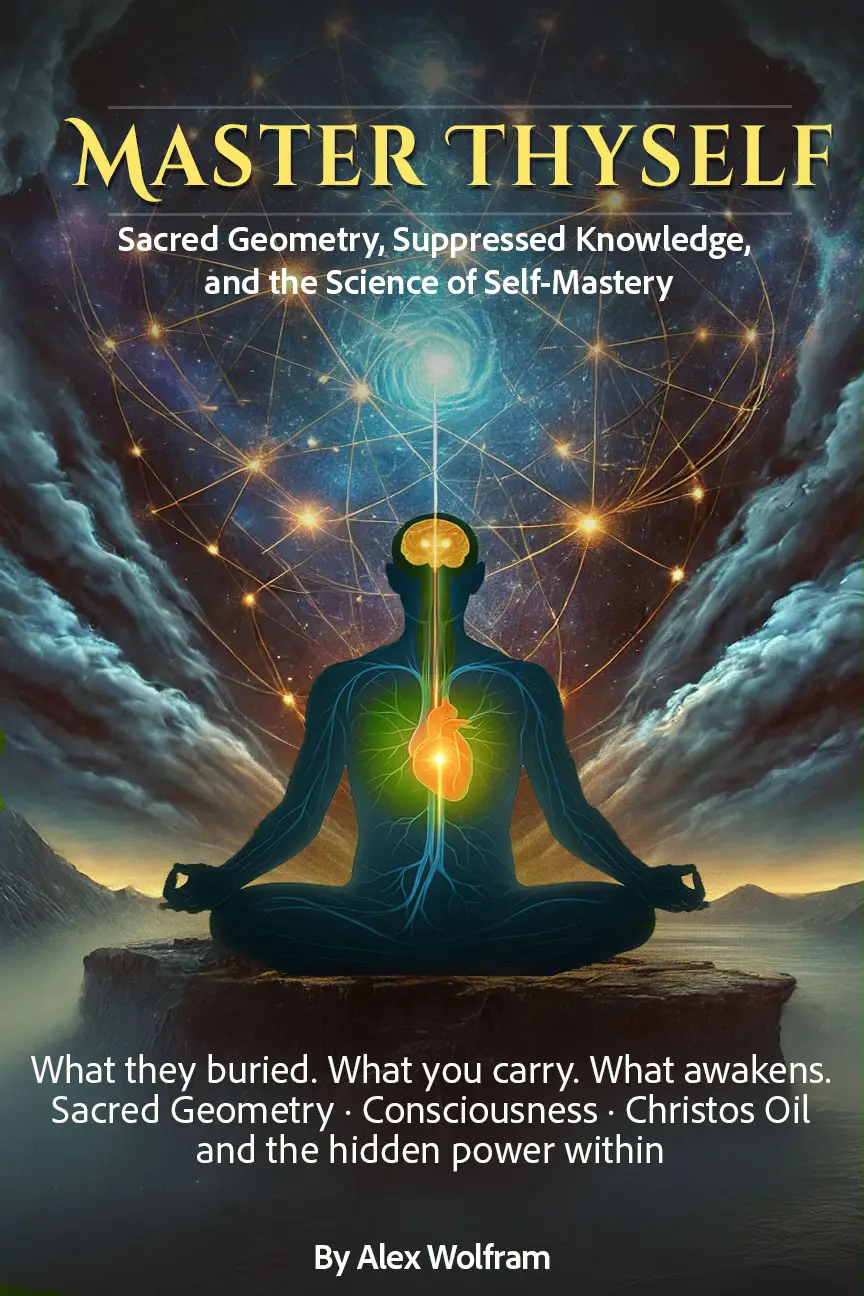
700+ pages. 24 chapters. The complete decoding of the claustrum, the cerebrospinal fluid pathway, the glymphatic system, and the inner anointing process the church externalized as chrism. The biology of awakening, with the sources cited.
30-day Amazon return guarantee. No risk.
The Djed Pillar and the Spinal Column
Egypt encoded the same anatomy. The Djed pillar is the most-repeated symbol in Egyptian religious art. A column with horizontal bars near the top. The "raising of the Djed" was an annual ceremony. What was being raised was not a wooden column.
The Djed pillar is the spinal column. The horizontal bars are the upper vertebrae, the segments where the rising current reaches the cranial chambers. The annual raising of the Djed was a public dramatization of an inner event. The same event Christianity later named the resurrection. The same event Hindu tradition named kundalini ascent.
When the inner anointing rises from the chamber down through the spine, makes the wilderness journey, and ascends back up the central channel, the Djed has been raised. The pillar that was lying flat (the spine of an unawakened body) stands upright (the spine of an awakened one). The biological signature that marks the moment the pillar finishes raising is Redacted, Chapter 21. The same image. The same event. Different vocabulary.
Boaz and Jachin, the two pillars of Solomon's Temple, are the same encoding. The flanking sympathetic chains. Ida and Pingala in yoga. The two thieves on either side of Christ at the crucifixion. Every culture mapped the same three-pillar structure because the body has three pillars: two flanking and one central. The current rises up the central one. The crucifixion happens at the optic chiasm where it crosses.
What Francis Crick Was Actually Saying
The final paper Francis Crick wrote, completed days before his death in 2004, made an argument most neuroscientists at the time found speculative. Crick proposed that this small brain structure, despite its size, served as a kind of conductor. A chamber that synchronized activity across the brain's many specialized regions into the unified experience we call consciousness.
The paper is titled "What is the function of the claustrum?" Co-authored with Christof Koch. Published in Philosophical Transactions of the Royal Society B in 2005. The metaphor Crick used was the orchestra conductor. The brain's many sections each play their part. The chamber binds them into one piece of music.
Subsequent research has supported the framing. A 2014 study reported that stimulating this structure in a single patient produced loss of consciousness during the stimulation and recovery the moment it ceased. The chamber was not the source of awareness. The chamber was the integrator. Without it, the streams of sensation existed but did not assemble into a unified self.
Esoteric tradition reached the same conclusion through introspection. Da'at is the bridge. The hidden eleventh Sephirah. The chamber consciousness must pass through to assemble itself coherently. The structure is the modern candidate for the seat of the soul, but its job is not to hold the soul in storage. The chamber's job is to weave it into wakefulness, moment by moment, breath by breath.
The full Crick claustrum hypothesis, with the citation chain and the cross-mapping to Da'at and the inner anointing process, is the opening biology of Redacted, Chapter 21.
Continue the Decoding
Each page covers a different chamber of the inner anatomy. The body is one system. The book maps it whole.
Mechanism Plus Practice
The claustrum is the where. Sacred Secretion covers the when and how. The lunar timing every monastic tradition encoded. The breath protocols. The conduct that preserves the inner oil long enough for it to ascend.
Same chapters, different focus.
Visit Sacred Secretion →When the Mainstream Started Paying Attention
For most of the twentieth century, this structure was a footnote in neuroanatomy textbooks. It changed in 2005 when Francis Crick, the Nobel laureate who co-discovered the structure of DNA, published a paper proposing it as the candidate site for the binding of conscious experience. Crick was working on the problem of how the brain unifies disparate sensory inputs into a single coherent moment of awareness. He concluded, after surveying the anatomy, that this small sheet of neurons was uniquely positioned to do the job.
The proposal did not solve the hard problem of consciousness, and Crick died shortly after publication, leaving the work to others. But it broke the structure out of obscurity. Since 2005, papers have multiplied, brain-stimulation studies in awake patients have shown that targeted activation of this region produces immediate loss of consciousness, and the convergence between Crick's hypothesis and the contemplative tradition's centuries-old claim about the seat of the soul has become harder to dismiss as coincidence.
The full structural breakdown, the operational implications, and the supporting evidence are covered in the book: Redacted, Chapter 14.
Master Thyself, Chapter 14Read The Inner Temple →Frequently Asked Questions
What is the claustrum?
A thin sheet of gray matter densely connected to almost every region of the cortex. Francis Crick proposed in his final paper that this structure functions as the brain's conductor. What it conducts, and how the inner anointing modulates it, is Redacted, Chapter 21.
Is the claustrum the seat of the soul?
Descartes picked the pineal in the 1640s. Crick picked the claustrum in 2005. The book treats both answers as half of one truth. The chamber the two glands form together is Redacted, Chapter 14.
Why did Francis Crick call this structure the seat of consciousness?
Crick argued that consciousness requires the binding of many specialized brain functions into a single unified experience. The unique connectivity of the structure made it the most plausible candidate. The full case, with citations, is Redacted, Chapter 21.
How is the chamber connected to cerebrospinal fluid?
The chamber sits adjacent to the third ventricle, where cerebrospinal fluid flows past the pineal gland. The hidden chamber and the sacred river are anatomically adjacent. The full pathway is Redacted, Chapter 21.
What is Peniel and how does it connect?
Peniel is the Hebrew place name from Genesis 32:30 where Jacob "saw God face to face." The word means "face of God" and is one letter from "pineal." The encoding is consistent across traditions: the inner encounter happens at Redacted, Chapter 21.
Where is this mechanism explained in full?
Chapter 21 ("Christos Oil") opens with the biology and the CSF pathway. Chapter 14 ("The Inner Temple") provides the supporting anatomy. The book is 700+ pages and 24 chapters total.
Still with us?
Twelve more questions.
Each of these threads is traced to its source in the fuller investigation. If any of them pull, that's the door.
What if Francis Crick spent his last years on a problem the Egyptian priesthood solved 3,000 years ago?
What if Da'at, the hidden Sephirah, is a specific brain structure modern neuroscience just rediscovered?
What if the seat of the soul is not one organ, but a chamber that two glands create when they lock into rhythm?
What if the inner anointing oil is a real biological substance produced in a specific chamber of the brain?
What if the church spent fifteen centuries hiding what every human body produces every day?
What if the Djed pillar of Egypt is the human spine, and "raising the Djed" is a measurable physiological event?
What if the binding of consciousness happens in a chamber you can name in three languages and feel in your own head?
What if Peniel and pineal share more than letters, they share an anatomical location?
What if cerebrospinal fluid is the "river of water of life" of Revelation, named plainly?
What if the holy of holies is a real chamber inside your skull?
What if Descartes was off by a few millimeters, and the seat of the soul is right next door to where he placed it?
What if the Church kept the symbol and forgot the biology?