Kabbalah
The mystical core of Judaism, the underlying geometry of Western esotericism, and the map of the human body and soul that Christian, Hermetic, and alchemical traditions kept under different names.
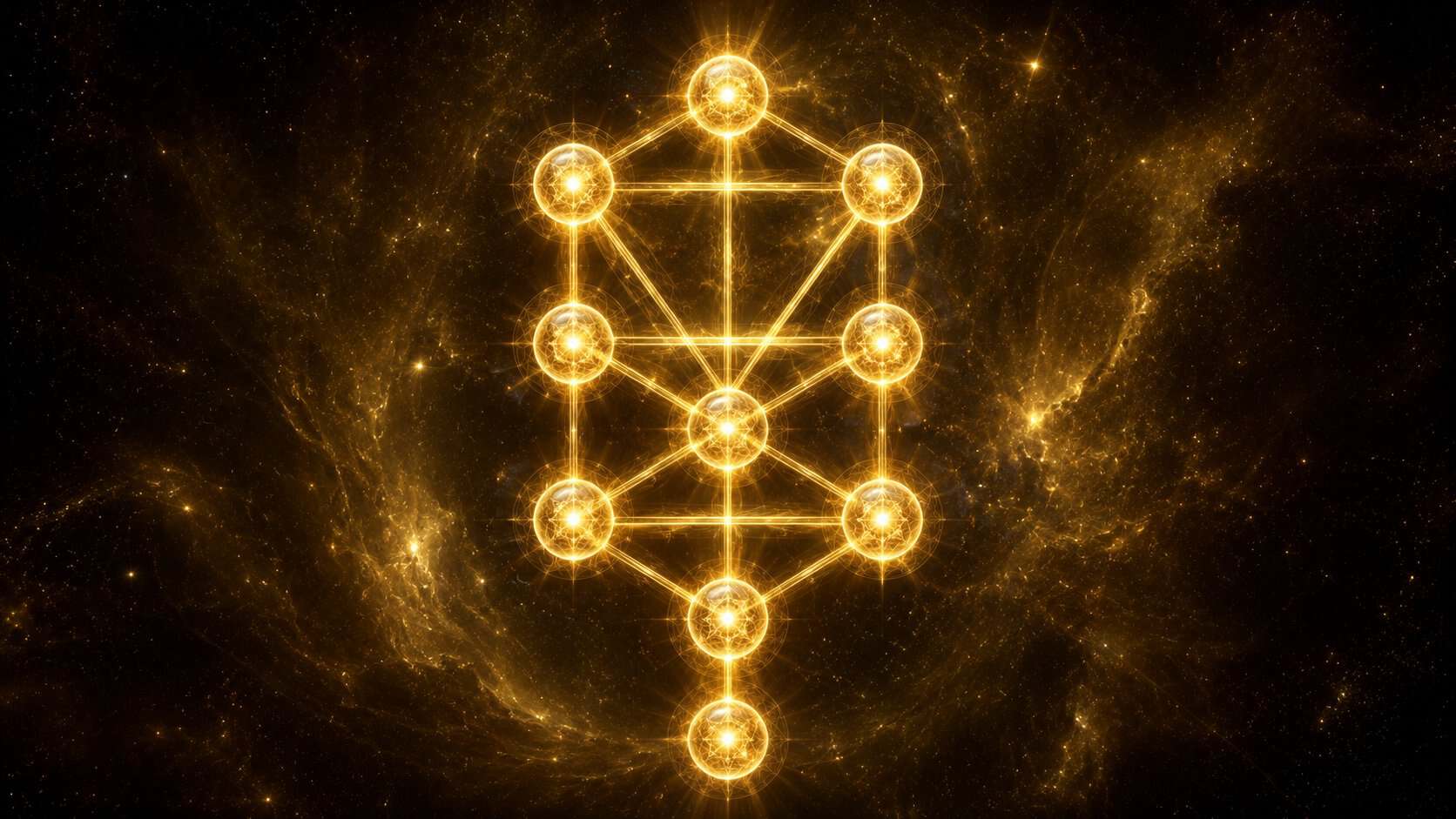
Kabbalah is not a religion. It is a system of esoteric interpretation that emerged from medieval Jewish mysticism, was absorbed almost wholesale into Renaissance Christianity and Hermetic thought, and now serves as the structural backbone of every serious Western occult tradition. At its center sits a single geometric diagram, ten luminous spheres connected by twenty-two paths, called the Tree of Life. That diagram is also a map of the human body.
This page covers what Kabbalah actually teaches, the ten sephirot of the Tree of Life, how the Tree maps onto the human body and the Christos Oil tradition this site is built around, the Christian and Hermetic versions, and why the same diagram keeps showing up across traditions that supposedly have nothing in common.
What Kabbalah Actually Is
The Hebrew word kabbalah (קַבָּלָה) means "received tradition." It is the esoteric, mystical branch of Judaism, dealing with the nature of God, the structure of creation, the soul, and the methods by which the human being can ascend back toward the divine. Where mainstream rabbinic Judaism focuses on ethics, law, and observance, Kabbalah focuses on the inner architecture of reality and the practices for navigating it.
The historical roots reach back to Merkabah mysticism in the Talmudic era (roughly 100 to 1000 CE), which centered on ecstatic ascent through heavenly chambers. The Kabbalah that became the dominant system, however, emerged in the 12th and 13th centuries in southern France and Spain. The two foundational texts are:
- Sefer Yetzirah (Book of Formation), a short, cryptic work attributed to Abraham but composed somewhere between the 2nd and 6th century CE. Describes creation as occurring through the twenty-two Hebrew letters and ten primordial numbers (the seeds of the sephirot).
- The Zohar (Book of Splendor), a massive multi-volume work attributed by tradition to Rabbi Shimon bar Yochai (2nd century CE), but composed by Moses de Leon in 13th-century Spain. The Zohar is the source most subsequent Kabbalah builds on.
After 1492, when the Jews were expelled from Spain, the tradition continued in Safed (Galilee), where Isaac Luria developed what became known as Lurianic Kabbalah. The Lurianic system, with its concepts of tzimtzum (divine contraction), shevirat ha-kelim (breaking of the vessels), and tikkun (repair), is the version most modern Kabbalah descends from. Hassidic Judaism, founded by the Baal Shem Tov in 18th-century eastern Europe, popularized Lurianic Kabbalah for non-scholarly Jews.
The Tree of Life and the Ten Sephirot
The Tree of Life is a diagram of ten sephirot (emanations, attributes of God), arranged in a specific geometric pattern, connected by twenty-two paths. The ten sephirot, from top to bottom, represent the progressive emanation of the divine into manifestation, and (read in reverse) the path of return.
Specific sequencing and full protocol: Redacted, Chapter 20.
- Keter (Crown): the unknowable source, pure being beyond form.
- Chokhmah (Wisdom): the first flash of differentiation, the active masculine principle.
- Binah (Understanding): the receptive feminine principle that gives form to wisdom.
- Chesed (Mercy / Lovingkindness): expansive, giving energy.
- Geburah (Severity / Judgment): restraining, structuring energy. The polar opposite of Chesed.
- Tiferet (Beauty / Harmony): the central balancing sephirah, often associated with the heart. Some readings: the Christos principle.
- Netzach (Victory / Eternity): the active emotion, desire, drive.
- Hod (Splendor / Glory): the receptive emotion, intellect, communication.
- Yesod (Foundation): the substrate of manifestation, often associated with the reproductive center, dreams, and the astral.
- Malkuth (Kingdom): the manifest world, the body, the physical.
A hidden eleventh sephirah, Daat (Knowledge), sits on the central pillar between Keter and Tiferet. Daat is the gap, the place where direct knowledge replaces inferred understanding. The Kabbalists treat Daat as not quite a sephirah but more than nothing. The location is precisely where the pineal gland sits anatomically.
The ten sephirot are arranged in three columns. The right column (Chokhmah, Chesed, Netzach) is the Pillar of Mercy, expansive and masculine. The left column (Binah, Geburah, Hod) is the Pillar of Severity, contractive and feminine. The center column (Keter, Daat, Tiferet, Yesod, Malkuth) is the Pillar of Equilibrium, the balanced middle path. Everything in the Tree mirrors the structure of polarity: every active principle has a passive counterpart, and the work is balancing the two.
The Tree Mapped onto the Human Body
The Tree of Life is not just a diagram of cosmic emanation. It is also a diagram of the human being. Each sephirah corresponds to a specific anatomical location, a specific endocrine gland, and a specific layer of psychological function. The vertical axis of the Tree maps onto the vertical axis of the spine.
- Keter sits at the crown of the head, corresponding to the pineal gland region or the very top of the skull. The crown chakra in the parallel Hindu system.
- Chokhmah and Binah sit at the temples or the right and left hemispheres of the brain. Wisdom is the intuitive flash, understanding is the structural elaboration.
- Daat (the hidden sephirah) sits at the third eye, the brow center, the pineal proper.
- Chesed and Geburah sit at the right and left shoulders or arms. The giving and restraining hands.
- Tiferet sits at the heart center. The balance point, the seat of the Christos.
- Netzach and Hod sit at the right and left hips or thighs. Active desire and receptive emotion.
- Yesod sits at the reproductive center, the sacral region. The foundation of manifest life.
- Malkuth sits at the feet, the connection to earth, the body as a whole.
The Hindu chakra system maps onto the same anatomy. The Daoist energy centers map onto the same anatomy. The Christos Oil tradition that names this site uses the same anatomical column. The Tree of Life is not a Jewish invention. It is a particular cultural encoding of a structure that traditions across the world independently recognized. The Kabbalists gave it the most systematic description.
Chapter 20. The Tree of Life.
The full Kabbalistic Tree mapped against six traditions: Christian mysticism, Hindu yoga, Daoist alchemy, Hermeticism, ancient Egyptian temple practice, and Sufi metaphysics. The cross-tradition correspondences. The anatomy. The Christos Oil connection in Chapter 21.
Christian Kabbalah and the Renaissance Synthesis
The transmission of Kabbalah from Jewish circles into Christian thought happened in waves. The most important wave hit during the Italian Renaissance. Pico della Mirandola (1463 to 1494), Johann Reuchlin (1455 to 1522), and later Athanasius Kircher (1602 to 1680) wrote extensively on what they called Christian Kabbalah, finding the Tree of Life perfectly compatible with the doctrine of the Trinity and the figure of Christ.
The central Christian-Kabbalistic move was to read Christ as Tiferet, the central balancing sephirah at the heart of the Tree. The cross-shape of the Tree (with Chesed and Geburah extending as arms, Keter as head, Malkuth as feet) was read as a literal map of the crucified body. Christ on the cross was Adam Kadmon, the cosmic man whose body is the Tree of Life. The crucifixion became not just a historical event but a cosmological one, the divine emanation reaching down through all ten sephirot into the densest level of manifestation and beginning the return path.
This reading was suppressed by the institutional church in the centuries that followed. The Gnostic gospels kept a parallel inner-Christianity alive that mapped well onto the Kabbalistic Tree. The Hermetic tradition that emerged from Hellenistic Egypt and Alexandria carried similar structures under different names. By the 19th century, the Hermetic Order of the Golden Dawn would synthesize all of these into a single working system.
As Above, So Below: The Tree as Universal Diagram
The Hermetic axiom as above, so below finds its cleanest geometric expression on the Tree of Life. Each sephirah is both a level of cosmic manifestation and a level of human anatomy. The same diagram describes the universe and the human body. Read more on the full meaning of "as above, so below".
The Hermetic Order of the Golden Dawn, founded in 1888 by Westcott, Mathers, and Woodman, formalized the synthesis. They added correspondences from every esoteric tradition they could integrate:
- Each sephirah received a planet (Keter = Neptune or beyond, Chokhmah = Uranus, Binah = Saturn, and so on down to Malkuth = Earth).
- Each of the 22 paths received a Tarot major arcana (the Fool, the Magician, the High Priestess, and so on, corresponding to the 22 Hebrew letters).
- Each sephirah received a color (the famous four-color scale, one color for each of the four worlds).
- Each sephirah received an archangel, a divine name of God, and a specific magical method of approach.
- The four Kabbalistic worlds (Atziluth, Beriah, Yetzirah, Assiah) mapped to the four elements (fire, water, air, earth) and the four-letter divine name YHVH.
Modern Western esotericism, including most occult orders, ceremonial magic, and serious symbolic Tarot work, runs on this Hermetic-Kabbalistic synthesis. The Tree of Life is the underlying grid. Whatever vocabulary the surface tradition uses, the structure is the same.
How Kabbalah Is Actually Practiced
Traditional Kabbalistic practice has several layers. The scholarly layer involves study of the Zohar, Sefer Yetzirah, and later commentaries. The contemplative layer involves meditation on the divine names, the Hebrew letters, and the structure of the Tree. The mystical layer aims at direct experience of the higher sephirot, with Keter as the eventual destination.
Common practices include:
- Sephirah meditation. Focusing on one sephirah at a time, contemplating its qualities, its color, its name of God, the corresponding archangel. Building familiarity with each before moving to the next.
- Pathworking. Inner journeys along the 22 paths between sephirot. The Tarot major arcana provide imagery for each path. Used to integrate the polarity of the sephirot the path connects.
- Permutation of the divine name. Hebrew letter combinations, particularly the four-letter YHVH (Tetragrammaton), as a contemplative focus. The Sefer Yetzirah is the source text for this practice.
- Tikkun. The Lurianic concept that each act, when performed with proper intention, contributes to the cosmic repair. Daily life becomes Kabbalistic practice.
- Devekut. Cleaving to God, sustained contemplation that aims at union. The Hasidic emphasis. The closest Kabbalistic concept to the contemplative ego death described in other traditions.
The pop-culture Kabbalah of the 1990s and 2000s, popularized by the Kabbalah Centre and celebrities, is a heavily simplified and commercialized version that traditional Kabbalists generally regard as something else entirely. The serious tradition requires Hebrew, sustained study, and a teacher. The accessible introduction is the symbolic structure of the Tree, which can be studied profitably without the language requirement.
What This Tradition Is Not
A surprising amount of confusion in modern writing on the topic comes from conflating things that the source literature carefully distinguishes. Four clarifications worth making upfront:
- It is not a Jewish-only inheritance. The roots are unambiguously Jewish (the foundational texts are in Hebrew, the Zohar is a Jewish work, and the major historical schools were Jewish), but the structural insights were adopted and extended by Christian and Islamic mystics, by Renaissance humanists, and by modern Western esoteric orders. Calling the broader tradition exclusively Jewish ignores how its diagrams and concepts traveled.
- It is not interchangeable with the New Age systems built on top of it. A great deal of contemporary spiritual writing borrows the Tree of Life diagram while discarding the disciplined textual study that the traditional schools required. The diagram without the textual grounding is a decoration. The textual grounding without the diagram is an academic exercise. The two together are the actual practice.
- It is not a divination system in the way Tarot is, though the two interact. The historical relationship between this tradition and Tarot is real but late and contested. The Tree of Life and the 22 Hebrew letters provide a framework that some Tarot decks have been mapped onto. The mapping is interpretive, not original to either system. Treating Tarot as straightforward applied Kabbalah misrepresents both.
- It is not separate from the everyday body. The Tree is mapped to the human body in the traditional texts in highly specific ways. The Sephirot are not just abstract attributes; they correspond to physical centers and physiological processes. The system was always meant to be embodied, not contemplated as pure abstraction.
Holding these distinctions in mind keeps the inquiry rigorous and prevents the most common errors that come from popularized treatments.
The full structural breakdown, the operational implications, and the supporting evidence are covered in the book: Redacted, Chapter 20.
Master Thyself, Chapter 20Read The Tree of Life →Frequently Asked Questions
What is Kabbalah in simple terms?
Kabbalah is the mystical and esoteric branch of Judaism, focused on the structure of reality, the nature of God, the soul, and the path of return to the divine. Its central diagram is the Tree of Life, ten emanations arranged in a specific geometric pattern, which also serves as a map of the human body and psyche.
Is Kabbalah Jewish or universal?
Kabbalah originated in Jewish mystical tradition and is rooted in Jewish theology, Hebrew language, and Torah interpretation. The structural diagram (the Tree of Life) has been adopted by Christian, Hermetic, and other Western esoteric traditions, so the underlying map is universal even though traditional Kabbalah is specifically Jewish.
What does Kabbalah teach about God?
Kabbalah teaches that God in essence (called Ein Sof, "the Infinite") is unknowable and beyond all attributes. God emanates into manifestation through the ten sephirot, which are accessible to human contemplation. The goal of mystical practice is to ascend back through the sephirot toward union with the source.
Is Kabbalah real or pseudoscience?
Kabbalah is a mystical tradition, not a scientific framework. It is real in the sense that it is a coherent system of symbolic interpretation with a thousand years of textual and practical development. It is not pseudoscience because it makes no claims to be science. Its value is evaluated by whether the practices produce the inner experiences the tradition claims, not by lab measurement.
What is the Tree of Life in Kabbalah?
A diagram of ten sephirot (divine emanations) arranged in three columns, connected by twenty-two paths. The Tree describes both the structure of cosmic emanation from God into manifest reality and the corresponding structure of the human being. The same diagram maps onto the human body, with each sephirah corresponding to a specific anatomical location and psychological function.
What are the 10 sephirot?
In order from highest to lowest: Keter (Crown), Chokhmah (Wisdom), Binah (Understanding), Chesed (Mercy), Geburah (Severity), Tiferet (Beauty), Netzach (Victory), Hod (Splendor), Yesod (Foundation), Malkuth (Kingdom). A hidden eleventh sephirah, Daat (Knowledge), sits on the central pillar between Keter and Tiferet.
Chapter 20. The Tree of Life.
The Kabbalistic Tree mapped through six traditions. The body, the soul, the inner architecture. The Christos Oil that rises through the central pillar. Cross-referenced through Christian mysticism, Hindu yoga, Daoist internal alchemy, Hermeticism, Egyptian temple practice, and Sufi metaphysics.
Get Your Copy on Amazon