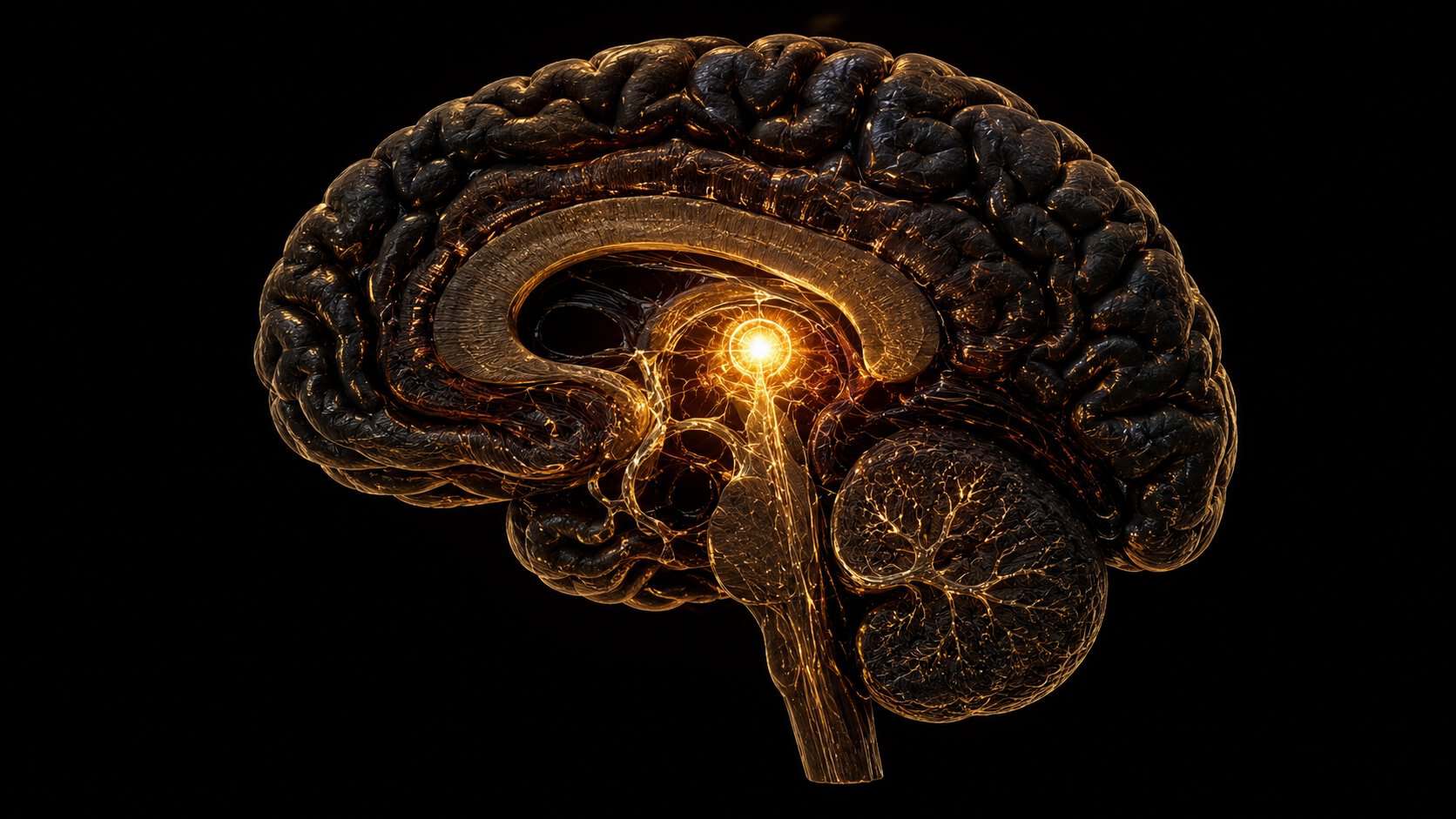
Pineal Gland
Descartes called it the seat of the soul. Every esoteric tradition called it the third eye. Modern endocrinology calls it a calcified speck most adult brains can't even photograph clearly.
The pineal gland sits at the geometric center of the human brain. In adults it is roughly the size of a grain of rice. It produces melatonin, regulates circadian rhythm, and according to a converging body of research, is involved in far more than that. The midline anatomy, the cross-cultural symbolism, and the modern measurement of its function all point at the same conclusion: this small gland is doing real work, much of which is suppressed by modern lifestyle, and traditional cultures had a working understanding of it long before modern science could explain why.
What follows is what the science actually says, what the wisdom traditions said, why the gland tends to calcify, what works to reverse the process, and the deeper connection to the Christos Oil tradition this site is built around.
What the Pineal Gland Actually Is
The pineal gland is a small endocrine organ located at the geometric center of the brain, tucked between the two hemispheres at the back of the third ventricle. Pine-cone shaped (hence the name, from Latin pineus), it is about 5 to 8 millimeters long in adults. Roughly the size of a grain of rice.
Several things make the pineal anatomically unique:
- It is the only unpaired midline structure in the brain. Every other brain organ has a left-side and a right-side. The pineal sits alone in the center.
- It is outside the blood-brain barrier. Unlike most of the brain, the pineal has full circulatory access, which means it sees everything circulating in the bloodstream. This makes it both a sensor and a vulnerability.
- It contains calcite microcrystals. Tiny crystal structures inside the gland are piezoelectric, meaning they produce voltage under pressure or vibration. The same principle that makes a crystal radio work.
- In lower vertebrates it is a functional photoreceptor. Lampreys, frogs, and lizards have a "parietal eye" on top of the skull that is structurally and embryologically the same organ as the human pineal. In humans the parietal eye has migrated inward but the photosensitive cell type remains.
The primary documented function is hormone production. The pineal converts serotonin into melatonin in response to darkness signals received via the retina-SCN pathway. Melatonin then regulates sleep, circadian rhythm, immune function, antioxidant activity, and seasonal cycles. Melatonin production declines with age and is suppressed by blue light exposure, including from screens in the evening. The decline correlates with most age-related diseases.
Why Every Tradition Called It the Third Eye
The pineal gland's location at the geometric center of the brain, its midline uniqueness, and its photoreceptive lineage all suggest something. Traditional cultures noticed. Across continents and millennia, the same organ shows up symbolically as a singular inner eye, a seat of perception, a gateway.
Specific sequencing and full protocol: Redacted, Chapter 13.
- Ancient Egypt: The Eye of Horus, when traced over an anatomical cross-section of the human brain, maps almost exactly onto the pineal-thalamus-hypothalamus region. The Eye of Ra and Eye of Horus are not abstract symbols. They are anatomical diagrams.
- Hinduism: The Ajna chakra (sixth chakra), traditionally located between the brows but anatomically deeper, governs intuition, vision, and transcendent perception. It is depicted as a single eye. See the deeper treatment on the third eye.
- Christianity: Matthew 6:22 reads "If thine eye be single, thy whole body shall be full of light." The Greek word translated as "single" (haplous) carries the meaning of singular, unified, undivided, focused. Read in the contemplative tradition, the "single eye" is the inner singular organ that the pineal anatomically is.
- Daoism: The upper dan tien, located at the brow center, is the seat of shen (spirit). Internal alchemy practices specifically work to clear and activate this center.
- Mesoamerican cultures: Mayan and Aztec stone reliefs frequently depict a pine cone held by the gods. The pine cone iconography also appears in Sumerian carvings, Egyptian art, Hindu iconography, on the papal staff, and on the Court of the Pine Cone in the Vatican.
- The mystery schools: Pythagoreans, Hermeticists, and the various initiatic traditions all treated this center as the locus of higher perception. The pine cone shows up in their art consistently.
The convergence is not a coincidence. Cultures that paid attention to subtle states of awareness independently identified the same anatomical region as the seat of those states. Modern neuroscience is slowly catching up to what these traditions had already mapped.
How the Pineal Gland Calcifies
Pineal calcification is not a hypothesis. It is measurable. MRI and CT scans routinely show calcium deposits in adult pineal glands. By age 40, most adults have visible calcification. By age 60, almost everyone does. The calcification is so common it is often used as a midline reference point for radiologists.
The drivers of calcification are well-documented:
- Fluoride. The pineal accumulates more fluoride than any other tissue in the body, including bones and teeth. A 2001 study by Jennifer Luke at the University of Surrey was the first to measure this directly. Fluoride creates fluorapatite crystals that displace the natural calcite crystals and reduce melatonin output. Read the deeper treatment on how to decalcify the pineal gland.
- Calcium dysregulation. When the body cannot direct dietary calcium properly (insufficient vitamin K2, insufficient magnesium, insufficient vitamin D), calcium settles in soft tissues like the pineal, arteries, and joints instead of bones.
- Chronic blue light at night. Suppresses melatonin production. A pineal that does not work is more vulnerable to calcification.
- EMF exposure. The pineal's piezoelectric crystals make it responsive to electromagnetic fields. Chronic exposure may disrupt function.
- Processed food and heavy metals. The pineal is outside the blood-brain barrier, so circulating contaminants reach it directly.
- Age. Some calcification appears to be a baseline aging process, but the rate varies enormously between populations and lifestyles, suggesting environment matters more than time.
A calcified pineal produces less melatonin. Less melatonin correlates with poorer sleep, weaker antioxidant defense, and higher rates of most age-related diseases. It also correlates, less measurably but consistently in tradition, with reduced capacity for the contemplative states the wisdom traditions valued.

The Full Picture.
The pineal gland sits at the center of Master Thyself's middle section. Chapter 13 covers its role in the body-as-temple framework. Chapter 14 covers its anatomy and the symbolism. Chapter 21 covers the Christos Oil tradition and the cerebrospinal fluid path that culminates here. Cross-referenced through six traditions.
Decalcification: The Real Path
The internet is full of decalcification protocols, some legitimate, most theatrical. The interventions with actual evidence are simpler than the marketing makes them sound.
- Eliminate or filter fluoride. Reverse osmosis or distillation removes it from drinking water. Switch to fluoride-free toothpaste. Avoid tea bags from low-quality sources (the tea plant is a fluoride accumulator). This is the single most impactful intervention.
- Vitamin K2 (MK-7 form). Directs dietary calcium to bones and teeth instead of soft tissues. Pairs with vitamin D3. Found in natto, hard cheeses, and grass-fed dairy.
- Adequate magnesium. Calcium without magnesium ends up in the wrong places. Magnesium glycinate or threonate is well-absorbed. Most modern diets are deficient.
- Iodine. Displaces fluoride and other halogens from receptor sites. Sea vegetables, eggs, dairy from iodine-rich areas. Supplementation should be careful and ideally guided.
- Periodic fasting. Autophagy clears cellular debris including in glandular tissue. The biblical fasting patterns the wisdom traditions practiced track closely with what modern research now supports.
- Real darkness at night. Blackout curtains, no screens after sunset, blue-blocking glasses if working late. Melatonin production requires actual darkness, not dim light.
- Morning sunlight. Sets the circadian rhythm, primes pineal function for the night. Look at the morning sun (not directly, at the horizon) for 5 to 10 minutes within an hour of waking.
- Reduce EMF exposure where reasonable. Wired connections at home, phones not in pockets, routers away from sleeping areas.
The traditions had simpler versions of most of this. Fast on the new moon. Sleep when it is dark. Eat real food. Stay outside in the morning. Drink clean water. The advice has not changed, only the explanations for why it works.
The Pineal's Deeper Function
Sleep and circadian rhythm are the documented functions. The contested but increasingly supported functions are where the pineal becomes genuinely interesting.
- Endogenous DMT. Rick Strassman's hypothesis that the pineal produces dimethyltryptamine during birth, death, and certain altered states was speculative when proposed in 2000. In 2013, researchers at the University of Wisconsin confirmed DMT presence in rat pineal microdialysate. The amounts are small but measurable. The exact role in humans is still being mapped, but the molecule that produces the most dramatic altered states is being made, at trace levels, inside the gland traditional cultures called the seat of inner vision.
- Near-death experiences. The convergent features of NDEs (tunnel of light, life review, feeling of unity, encounter with non-physical intelligences) match closely with the experience of high-dose DMT. The pineal becomes very active in dying brains based on recent EEG studies of terminal patients. The mechanism is not proven but the correlation is striking.
- Dreams. REM-state DMT release has been hypothesized as the mechanism of vivid dreaming. Dream content during heavy REM phases overlaps with reported features of waking visionary experience.
- Contemplative states. Long-term meditators show measurable differences in pineal function and morphology. Whether the practice changes the gland or pineal genetics influence who pursues the practice is still being researched.
The conservative reading: the pineal does more than melatonin production. The bolder reading: the pineal is the anatomical seat of the contemplative capacity the wisdom traditions spent millennia trying to develop. The traditions did not have fMRI. They had subjective experience and reverse-engineered methods that worked. Modern science is now confirming, gland by gland, what they already knew.
Where the Oil Goes
This site is named for the Christos Oil tradition, the inner alchemy practice preserved in fragments across Christian mysticism, Hinduism (kundalini), Daoism (internal alchemy), and ancient Egyptian temple practice. The tradition describes a substance, a literal physical fluid, that rises up the spine to the brain at specific moments and at specific times in the lunar cycle. The biblical word for it is chrio in the Greek. Christos means "the anointed one," and the anointing is an oil. The anointing happens in the head, at the pineal.
The anatomical fluid in question is cerebrospinal fluid. CSF circulates around the brain and spinal cord, bathing the central nervous system, and is produced in the brain ventricles, including the third ventricle adjacent to the pineal. Traditional descriptions of the inner anointing match the modern understanding of CSF flow, with elements of pineal-mediated neurochemistry layered on top.
The sacred secretion calendar tracks the lunar cycle for the timing the traditions specified. Read the claustrum treatment for the deeper neuroanatomy. The pineal is one node in a longer architecture, but it is the node where the inner anointing reaches its destination.
Where the Research and the Tradition Agree
There is a tendency in popular spiritual writing to overstate what mainstream science says about this small endocrine structure. There is also a tendency in mainstream science to understate what is actually anomalous about it. The honest position lives between those two errors.
What the peer-reviewed research has demonstrated, with reasonable certainty:
- Melatonin production is concentrated here, and disruption of that cycle has cascading effects on sleep, immune function, and circadian regulation.
- The tissue accumulates calcium phosphate over the lifespan, with rates that vary widely between individuals and populations. The accumulation correlates with fluoride exposure in animal studies.
- The structure is unique in not being protected by the blood-brain barrier in the way other brain regions are, which makes it metabolically distinct and unusually sensitive to circulating compounds.
- It produces several neurochemicals beyond melatonin whose functions are not fully characterized in the published literature.
What contemplative traditions have asserted, with millennia of converging testimony from practitioners who did not coordinate across cultures:
- Specific practices can shift the state of this organ measurably, producing experiences that practitioners describe in remarkably consistent terms across traditions.
- Diet, light exposure, and certain disciplines affect the practitioner's capacity to access those states.
- The organ is, in the contemplative analysis, a physical correlate of perceptual functions that ordinary attention rarely accesses but that all humans appear to possess at the structural level.
Where the published research and the contemplative testimony agree is the most useful place to stand. Where they disagree is the open question. Honest engagement with either side requires acknowledging both.
The full protocol, the specific sequencing, and the why behind each step are covered in the book: Redacted, Chapter 14.
Master Thyself, Chapters 13, 14, 21Read The Inner Temple →Frequently Asked Questions
Where is the pineal gland located?
In the center of the brain, at the back of the third ventricle, between the two hemispheres. It is the only unpaired midline structure in the brain.
What does the pineal gland do?
The documented function is producing melatonin in response to darkness, which regulates sleep, circadian rhythm, and seasonal cycles. The pineal also has antioxidant effects, supports immune function, and has been implicated in producing trace amounts of DMT in some species.
Can you really decalcify the pineal gland?
Decalcification in the strict sense (reversing existing crystallization) is difficult and slow. Preventing further calcification and improving the function of the remaining tissue is achievable through fluoride elimination, proper calcium-directing nutrients, periodic fasting, and proper darkness exposure at night.
Is the pineal gland the same as the third eye?
Anatomically, yes, in most traditional interpretations. The third eye, the ajna chakra, the single eye in the Sermon on the Mount, the Egyptian Eye of Horus, all reference the same midline cranial structure that modern anatomy identifies as the pineal gland and its surrounding tissue.
What is the connection between DMT and the pineal gland?
DMT (dimethyltryptamine) is the molecule responsible for the most intense visionary states reported in psychedelic experiences. Rick Strassman hypothesized in 2001 that the pineal produces DMT endogenously. In 2013, DMT was confirmed in rat pineal microdialysate. The role in humans is still being mapped but the connection is real, not folklore.
Does fluoride calcify the pineal gland?
Yes. A 2001 University of Surrey study by Jennifer Luke measured pineal fluoride concentration directly and found it higher than in any other tissue, including bones and teeth. Fluoride displaces natural calcite crystals and reduces melatonin output. Filtered water and fluoride-free toothpaste are the easiest interventions.
Chapters 13, 14, and 21. The Inner Temple.
The full anatomical excavation, the cross-cultural symbolism, the modern research on melatonin and DMT, the decalcification protocols, and the Christos Oil tradition that places the pineal at the destination of the inner anointing. Cross-referenced through six traditions.
Get Your Copy on Amazon