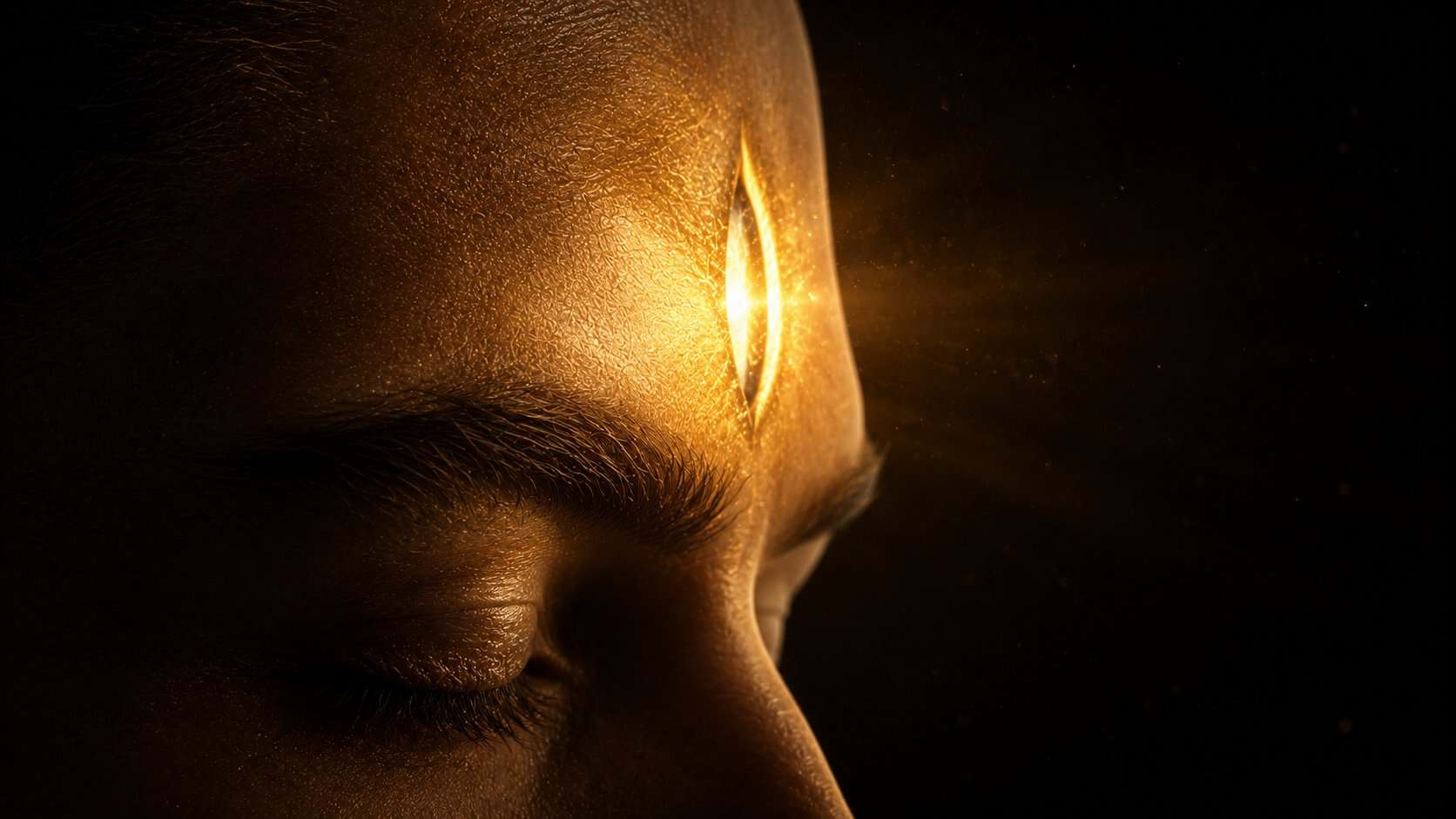
Third Eye
The pineal gland in anatomy, the ajna chakra in yoga, the single eye in scripture, the seat of inner vision in every tradition that ever took perception seriously.
The third eye is not a metaphor. It is an anatomical structure, an energetic center, and a perceptual capacity. The traditions that mapped it knew it from three angles simultaneously. The pineal gland sits at the geometric center of the brain. The ajna chakra sits at the brow. The "single eye" of Matthew 6:22 sits in the same location in scripture. Three vocabularies, one organ.
This page covers what the third eye actually is across these three layers, why every contemplative tradition gave it the same name, how to recognize its activation, and the practical work of opening it. The deeper Christos Oil anatomy is what this site is built around.
What the Third Eye Actually Is
The third eye has three layers of meaning, all of which point at the same general region of the human head. The traditions did not pretend the layers were unrelated. They built coherent systems where the anatomy, the energy, and the perception were three views of the same fact.
- The anatomical layer. The pineal gland, an endocrine organ at the geometric center of the brain, embryologically the same tissue as the parietal "third eye" still visible on the heads of lampreys, lizards, and some frogs. In humans the organ has migrated inward but retained its photosensitive cell lineage. It produces melatonin and, in small amounts, neurochemicals associated with visionary states.
- The energetic layer. The ajna chakra in Hindu yoga, the upper dan tien in Daoist alchemy, the brow center in Sufi practice. Described as a wheel of light, an indigo or violet color, located at the brow but radiating inward to the center of the head. Activated through specific breath, posture, and concentration practices.
- The perceptual layer. The capacity for direct, non-sensory knowing, the kind humans report when they have a feeling about a person they have just met, when they dream a fact they could not have known, when they intuit a truth without being able to trace the evidence. The traditions called this buddhi in Sanskrit, nous in Greek, gnosis in early Christianity.
The traditions did not separate these layers because they understood them as three views of one phenomenon. Modern neuroscience is starting to confirm: the pineal correlates with subjective intuitive experience, glandular function correlates with subtle perception, and the contemplative traditions that emphasized this center produce measurable changes in attention, intuition, and decision-making.
The Physical Third Eye
Several anatomical structures are involved in what the traditions called the third eye. The pineal gland is the most famous, but it does not work alone.
Specific sequencing and full protocol: Redacted, Chapter 14.
- The pineal gland. Geometric center of the brain. Pine-cone shaped, about 5 to 8 millimeters in adults. Only midline structure in the brain. Outside the blood-brain barrier. Contains piezoelectric calcite crystals. Embryologically photoreceptive. Produces melatonin and, per recent research, trace endogenous DMT. The strongest single candidate for the anatomical seat of the third eye. Full treatment on the pineal gland page.
- The optic chiasm. The X-shaped crossing of the optic nerves just in front of the pituitary. The point where the visual information from the two eyes converges before being routed to the visual cortex. Traditions read it as the symbolic crossing of "two becoming one." Detailed treatment on the optic chiasm.
- The claustrum. A thin sheet of neurons connecting many cortical regions, currently considered a leading candidate for the neural correlate of consciousness binding. Activation correlates with unified awareness. Full treatment on the claustrum.
- The glabella. The bony area between the eyebrows. The external landmark of the third eye in many iconographies (the bindi in Hindu women's traditional dress, the tilaka, the ash mark of Shiva). Sits directly above the optic chiasm and just inward of the pineal.
The Christos Oil tradition, which is what this site is named for, treats these structures as a connected anatomy. Cerebrospinal fluid (the inner "anointing" oil) rises through the spinal column and bathes this entire region at specific times. The traditional sequence is: optic chiasm, pituitary, claustrum, pineal. The "single eye" of scripture is the integrated function of this complex, not any one structure in isolation.
Why Every Tradition Named It
The cross-cultural convergence is striking. Cultures that never met, that did not share trade or religious traffic, that worked in different languages and different gods, all named the same region of the human head as the seat of inner perception.
- Ancient Egypt. The Eye of Horus, traced over an anatomical brain cross-section, maps almost exactly onto the pineal-thalamus-hypothalamus region. The Eye of Ra is the same organ from a different angle.
- Hinduism. The ajna chakra, sixth of the seven primary chakras, located at the brow center. Depicted as a single eye. Associated with intuition, vision, perception beyond the senses, and the union of the two physical eyes into one inner sight.
- Buddhism. Buddhist statues frequently show a third eye at the brow, called the urna. Sometimes shown as a curl of hair, sometimes as a jewel, sometimes as an actual third eye. Indicates spiritual perception and enlightenment.
- Daoism. The upper dan tien, located at the brow center and extending into the brain. The seat of shen (spirit). Internal alchemy practices focus on clearing and activating this center.
- Christianity. Matthew 6:22, the "single eye" passage. The Greek word translated as "single" (haplous) means singular, unified, undivided. The contemplative tradition reads this as a direct reference to the inner integrated eye, the one organ that, when functional, produces inner light. See I Am the Way for the deeper Christian reading.
- Sufism. The basira (inner sight) is the capacity that develops when the heart is purified. Located symbolically at the brow but understood as a perceptual function.
- Mesoamerican cultures. Mayan and Aztec carvings include figures with prominent third eyes, often holding a pine cone (the structural shape of the pineal gland).
- The mystery schools. Pythagorean, Hermetic, and Egyptian initiatic traditions all worked with this center. The pine cone iconography in their art is consistent and pointed.
The pattern is not a coincidence. Cultures that paid close attention to internal states identified the same anatomical region. The vocabulary differs. The anatomy is the same.
Chapter 14. The Inner Temple.
The full anatomical excavation of the third eye complex, the Christos Oil pathway, and how every tradition mapped the same anatomy. Chapter 21 then traces the inner anointing's full path from spine to skull. Cross-referenced through six traditions.
Matthew 6:22 and the Christian Reading
The clearest scriptural reference to the third eye in the Christian canon is Matthew 6:22, in the Sermon on the Mount. "The light of the body is the eye: if therefore thine eye be single, thy whole body shall be full of light." The Greek word for "single" is haplous, which carries the meaning of singular, unified, sound, healthy, undivided. Compare to diplous, double, the linguistic opposite.
Read in the contemplative Christianity that flourished in the desert monastic tradition and was carried forward by figures like Meister Eckhart, the "single eye" is not the physical eyes at all. The physical eyes are two. The single eye is the inner organ that produces inner light. The passage is a practical instruction: if the inner eye is integrated and functional, the entire body becomes a vessel of light.
The institutional church largely lost this reading over the centuries. The Gnostic gospels kept it alive. The Gospel of Thomas, logion 22: "When you make the two one, and when you make the inside like the outside and the outside like the inside, and the above like the below... then you will enter the kingdom." The integration of the two eyes into the single eye is the same operation as making the two one.
The contemplative reading is supported by the linguistic precision of the Greek. The institutional reading flattened haplous into a generic moral instruction (have a "good" or "pure" eye, meaning be virtuous). The original carries something much more specific: there is an integrated inner organ, and when it is functional, the whole person becomes a vessel of light.
Signs the Third Eye Is Opening
The traditions describe specific phenomena that accompany an activating third eye. Modern reports from contemplative practitioners are remarkably consistent with the traditional descriptions. The phenomena are not proof of anything cosmic, but they are recognizable patterns.
- Pressure or tingling at the brow. A subtle physical sensation in the area between and slightly above the eyebrows. Often described as a buzzing, a tingling, or a sense of pressure from inside the skull pushing outward at that point.
- Vivid dreams. Dream content becomes more coherent, more memorable, and more often instructive. The traditions treated dreams as one of the modes of third-eye perception.
- Intuition without source. Knowing things without being able to trace the evidence. A correct sense about a person or situation that arrives whole, not piece by piece.
- Synchronicity. An increase in meaningful coincidences. Whether this is a real change in events or a change in perception of events is debated. The phenomenology is consistent.
- Light phenomena. Internal visual phenomena during meditation: points of light, geometric patterns, soft inner glow. Common during sustained concentration practice.
- Discernment. Faster, sharper recognition of falsehood and truth in situations. The conceptual mind takes longer to verify than the integrated inner perception takes to recognize.
A warning the traditions consistently emphasized: these phenomena are not the goal. They are signs along the way, like the symptoms of physical conditioning. The goal is integrated perception, not visual effects. Practitioners who fixate on the effects often stop progressing. The right relationship is to notice the signs and continue the practice.
How to Open the Third Eye
Opening the third eye has two halves. The first is removing the obstructions. The second is developing the capacity. Both are needed. The traditions converge on a small handful of methods that show up across every system that took this seriously.
- Decalcify the pineal. The first obstruction. Fluoride elimination, vitamin K2, periodic fasting, real darkness at night. Detailed protocol on how to decalcify the pineal gland.
- Sustained concentration. The capacity to hold attention on one object without distraction is the foundational practice in every tradition. Breath, mantra, candle flame, a single internal sensation. The traditions are consistent: develop this first.
- Brow-center attention. Specific practice of placing attention at the third eye location during meditation. Yogic shambhavi mudra. Hindu trataka on a candle, then internalized. Daoist focus on the upper dan tien.
- Sun gazing at safe times. Sunrise and sunset only, no more than 10 to 15 minutes, eyes relaxed. Traditional practice across many cultures. Modern science suggests dawn and dusk light has measurable effects on melatonin regulation and circadian function.
- Fasting. Periodic fasting clears the body and sensitizes perception. The biblical fasting patterns the traditions used are the proven version.
- Real darkness. Sleeping in true darkness allows pineal function to recover. Blackout curtains, no screens after sunset.
- Sound and frequency. Specific frequencies (the solfeggio frequencies, especially 936 Hz, traditionally associated with the third eye) used as meditative focus. Effects are real but subtle.
- Inquiry. The practice of asking "who is seeing this?" and following the question inward. Ramana Maharshi made this the heart of his teaching. The integrated perception that emerges is what the traditions called the inner eye.
None of these is dramatic. None of them produces overnight results. The traditions estimated the work in years and decades, not weeks. The compound effect is real but slow. Patience, sustained practice, and a clear motivation distinguish those who actually do this work from those who collect techniques.
What Most Modern Approaches Get Wrong
The contemporary spiritual marketplace has built a substantial industry around the topic, and most of what gets sold is partial or actively misleading. Six common mistakes show up across most popular books, courses, and influencer content:
- Treating it as a single binary switch. Popular framing suggests there is an "open" state and a "closed" state. The actual anatomy is a spectrum across multiple layers with multiple gating mechanisms. Different layers respond to different inputs and open at different speeds.
- Ignoring the physical platform. Pineal calcification, mineral deficiency, melatonin suppression from blue light, and chronic cortisol elevation all degrade the platform. No amount of meditation overrides a degraded substrate. The body comes first; the practice rests on it.
- Promising fast results. Genuine development takes months at minimum, often years. Programs that promise "open it in 21 days" are either misrepresenting what they deliver or training a temporary state that does not stabilize.
- Skipping safety. Rapid opening without proper grounding can destabilize the nervous system. Traditional schools spent years on preparation before initiation precisely because the opening sequence has known risks. Skipping that preparation in favor of speed is a recipe for problems.
- Confusing experience with development. A psychedelic, a deep meditation, or an intense breathwork session can produce dramatic experiences. The experiences are real. The capacity that gets built through sustained practice is what lasts. Tourists collect experiences; practitioners build capacity.
- Selling the practice without the framework. The practices work because they fit into a larger understanding of why and how. Sold in isolation as techniques, they often produce confused, fragmented results. The technique without the map is much less effective than either is with the other.
A reasonable approach inverts most of these mistakes. Treat the body as the platform. Treat the practice as a long apprenticeship. Treat safety as nonnegotiable. Treat the framework as essential context, not optional theory. Then the practice produces what it is supposed to produce.
The full protocol, the specific sequencing, and the why behind each step are covered in the book: Redacted, Chapter 14.
Master Thyself, Chapter 14Read The Inner Temple →Frequently Asked Questions
What is the third eye?
The third eye is the traditional name for an integrated anatomical and energetic center in the head, comprising the pineal gland, the optic chiasm, and the claustrum, located at the geometric center of the brain. It is described across traditions as the seat of inner vision, intuition, and direct knowing. Anatomically it is the pineal complex. Energetically it is the ajna chakra. Perceptually it is the capacity for non-sensory knowledge.
Is the third eye the same as the pineal gland?
Anatomically, the third eye is most directly associated with the pineal gland, but most traditions include the surrounding structures (optic chiasm, claustrum, pituitary, glabella) as part of the third eye complex. The pineal is the central organ but not the only one.
Is the third eye real?
The anatomical structures are real (pineal gland, optic chiasm, claustrum). The energetic and perceptual phenomena reported by practitioners are subjectively real and well-documented across cultures. Whether the experiences correspond to objective non-physical realities is a separate question that remains debated.
How long does it take to open the third eye?
The traditions estimated the work in years to decades, not weeks. Initial signs (pressure, vivid dreams, subtle perception shifts) often arise within months of consistent practice. Stable integration usually requires sustained practice over a much longer period. Anyone promising overnight results is selling something the traditions did not recognize.
Can fluoride affect the third eye?
Yes. Fluoride accumulates in the pineal gland more than in any other tissue, including bones. A 2001 University of Surrey study by Jennifer Luke measured this directly. The fluoride creates fluorapatite crystals that displace the natural calcite crystals and reduce melatonin output. The practical implication: filter your drinking water and use fluoride-free toothpaste.
What's the difference between the third eye and the third eye chakra?
The third eye is the broader concept, including anatomy, energy, and perception. The third eye chakra is specifically the Hindu yogic vocabulary for the energetic component, the ajna chakra at the brow center. The two terms are often used interchangeably but the chakra term is rooted specifically in the yogic system.
Chapter 14. The Inner Temple.
The full anatomy of the third eye complex, the cross-cultural symbolism, the Christian "single eye," the Christos Oil pathway, and the practical opening work. Cross-referenced through six traditions.
Get Your Copy on Amazon