Ancient Temples Are Maps
of the Human Body
Four civilisations. No documented contact between them. The same floor plan, built in four different stones, on four different continents.
Ancient temples human body: four civilisations with no contact between them built the same building, because they were all reading the same source -- the architecture of the human body itself.
The Same Floor Plan: Ancient Temples and the Human Body
Lay the floor plans of Solomon's Temple, the Greek Temple, the Gothic Cathedral, and Angkor Wat side by side. The same structure appears in all four.
| Element | In the Building | In the Body |
|---|---|---|
| Outer boundary | Moat, outer wall, narthex | Skin, the senses |
| Outer court | First enclosure | Lower energy centres |
| Inner court | Second enclosure | Heart centre |
| Innermost sanctuary | Central tower or Holy of Holies | Skull (Golgotha), pineal chamber |
| Central axis | Causeway or nave, entrance to crown | Spinal column, 33 vertebrae |
| Restricted access at top | King and high priest only | Purification required for the Christos ascent |
| 7 ascending thresholds | Gateway towers or nave sections | 7 chakras ascending the spine |
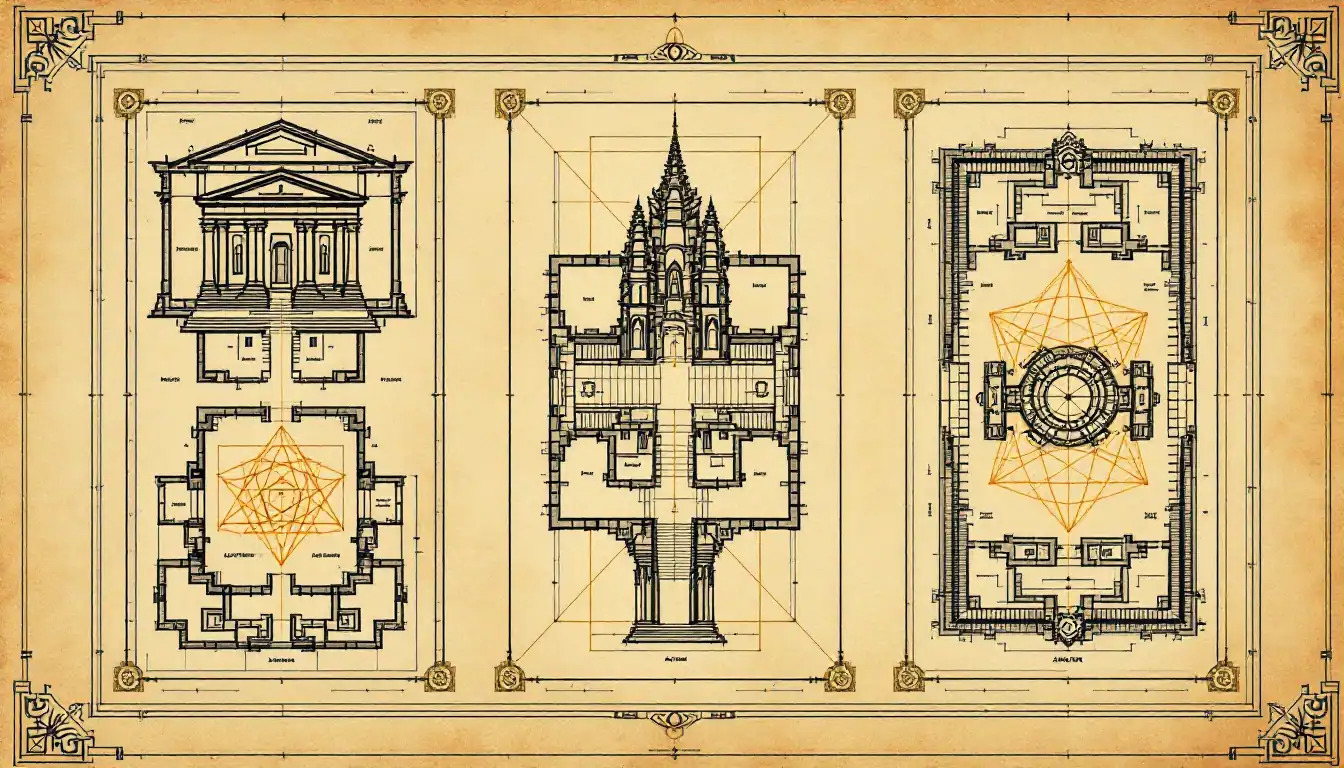
Fig. 1 — Architectural floor plan comparison: Solomon's Temple, Greek Temple, Gothic Cathedral, Angkor Wat. Sacred geometry overlay in gold. One template, four civilisations.
Paul stated it directly: "Know ye not that ye are the temple of God?" (1 Corinthians 3:16). This was not encouragement to eat well. It was an anatomical statement. The builders of every sacred structure on earth understood it the same way.
What Solomon's Temple, the Greek Temple, and the Gothic Cathedral each conceal at their crown -- the specific anatomical identity of what passes through the Holy of Holies during the Christos ascent -- is Redacted, Chapter 13. The measurement ratios proving the floor plan was deliberate, not coincidental, are Redacted, Chapter 14.
The 7 Thresholds and the 33
Two numbers appear in sacred structures across every culture that preserved the inner map. They are not symbolic preferences. They are anatomical counts.
The 33
The human spine has exactly 33 vertebrae. Jesus ministered for 33 years. Freemasonry has 33 degrees. The Vedic tradition placed 33 gods on the Sacred Mountain (Mount Meru -- literally "the spine" in Sanskrit). At Phnom Bakheng, 33 towers are visible from the structure's centre. Every tradition that encoded the inner path arrived at the same count because the count was never invented. It was read from the anatomy.
The full cross-tradition breakdown is at The 33.
The 7
The 7 ascending thresholds in sacred architecture correspond to the 7 chakras ascending the spinal column: base, sacral, solar plexus, heart, throat, third eye, and crown. You do not pass freely from the outer court to the innermost sanctuary. You ascend through 7 gates. The same 7 appear as the 7 seals in Revelation, the 7 days of creation, the 7 notes of the musical scale, and the 7 levels of the Buddhist heaven at Phnom Bakheng.
The Temple That Should Not Exist
In 12th-century Cambodia, a civilisation with no documented contact with the Hebrew, Greek, or Christian traditions built the largest religious structure on earth. It encodes the same map.
Angkor Wat covers 400 acres. Its central tower rises 213 feet. The moat runs 3 miles in circumference. The causeway to the entrance is 1,500 feet long. Built by King Suryavarman II, dedicated to Vishnu, constructed by an estimated 300,000 labourers over 35 years.
Its floor plan matches Solomon's Temple: outer court, inner court, single innermost sanctuary, central axis, restricted access at the crown. The 5 towers at the summit represent the 5 peaks of the Sacred Mountain (Mount Meru) -- the same five-point geometry as the human body outstretched.
The eastern gallery contains a 49-metre relief -- the Churning of the Cosmic Ocean (Samudra Manthan) -- that functions as a working solar calendar. The central tower's axial dimensions, measured in the Cambodian unit of length (hat), sum to 365.37: the solar year to four decimal places. Confirmed in peer-reviewed research in Science (Stencel, Gifford, and Moron, 1976).
The spring equinox alignment is the same astronomical anchor as Easter. The lunar arc encoded in the relief (54 + 54 = 108) corresponds to the same monthly biological window as the Christos Oil timing cycle. The temple faces west -- toward death, toward descent -- because you enter from the side of dying and walk east toward the crown.
The Christos Oil Carved in Stone
The great eastern relief depicts the Churning of the Cosmic Ocean (Samudra Manthan). Every element maps directly onto the Christos Oil physiology of Chapter 21.
| Relief Element | Christos Path Equivalent |
|---|---|
| Central mountain, "clarified butter" (Mount Mandara) | Spinal column, 33 vertebrae |
| Serpent rope coiled around it (Vasuki) | Twin currents (Ida and Pingala) -- see Kundalini |
| Ocean being churned, the Milk Ocean (Kshira Sagara) | Cerebrospinal fluid -- the Christos Oil substrate |
| Immortality nectar produced (Amrita) | Christos Oil ascending to the pineal gland |
| 88 gods (Devas) pulling | Ascending solar current, right pillar |
| 92 anti-gods (Asuras) pulling | Descending lunar current -- the imbalance of 92 to 88 is why Redacted, Chapter 19 sustained discipline is required |
| Serpent crossing at the mountain, the Chi (X) | Optic chiasm -- the anatomical cross between pineal and pituitary |
| Poison before the nectar (Halahala) | Day 2 of the fast -- autophagy peak. What surfaces before Redacted, Chapter 22 the nectar arrives. |
The ocean is explicitly called the Milk Ocean (Kshira Sagara). The land flowing with milk and honey was never only geography. The Churning of the Cosmic Ocean is the same physiology as the Christos Oil ascent, told from outside the body rather than inside it.
Full Christos Oil Physiology Read Chapter 21 →The Companion Temple: Built 200 Years Earlier
1.3 kilometres north of Angkor Wat stands Phnom Bakheng -- a Shiva temple built around 900 CE by King Yasovarman I. Two separate kings. Two centuries apart. The same encoded map.
Where Angkor Wat encodes the churning process, Phnom Bakheng encodes the anatomy of the ascent itself:
| Number | In the Temple | In the Body |
|---|---|---|
| 7 levels | 7 ascending tiers of the pyramid structure | 7 chakras ascending the spine |
| 5 towers | 5 peaks of the Sacred Mountain (Mount Meru) at the crown | 5 extremities of the human body, 5 senses |
| 12 towers per terrace | 12-year cycle of Jupiter encoded per level | 12 cranial nerves, 12 Christos stages, 12 apostles |
| 33 visible from centre | 33 towers visible from any side at ground level | 33 vertebrae of the spinal column |
| 108 total towers | 4 lunar phases x 27 days = 108 | 54 + 54, same as the lunar arc in the Angkor Wat churning relief |
The Sanskrit word Meru carries three documented meanings: peak, axis, and spine. The Sacred Mountain was never a mountain. It was always the spinal column.
Why Independent Civilisations Built the Same Building
The standard academic explanation for architectural convergence is cultural transmission. That explanation fails here. The Hebrew, Greek, European Christian, and Khmer civilisations had no documented contact during the periods in which these structures were built. And yet the floor plan matches.
The alternative explanation -- which every chapter of Master Thyself builds toward -- is that these civilisations were not copying each other. They were reading the same source independently. The source is the human body.
"The kingdom of God is within you."
Luke 17:21 -- This was not a comfort phrase. It was an instruction about where to look.The body has a central axis of 33 vertebrae. It has 7 ascending energy centres. It has an innermost sanctuary -- the skull -- accessible only after the lower levels have been traversed and the Christos Oil preserved and directed upward. It has a hidden chamber at the top, the claustrum -- whose specific role in the anointing is Redacted, Chapter 21 and what Francis Crick identified as a candidate for the seat of consciousness itself.
The Kundalini tradition describes the same ascending path through the same 7 centres. The Kabbalistic Tree of Life maps the same 3-pillar structure onto the body's energy anatomy. The Christos Path traces the same 12-stage journey through named anatomical landmarks. The temple architecture is the same map drawn in stone instead of text.
The Full Cross-Tradition Analysis Read Chapters 13 and 14 →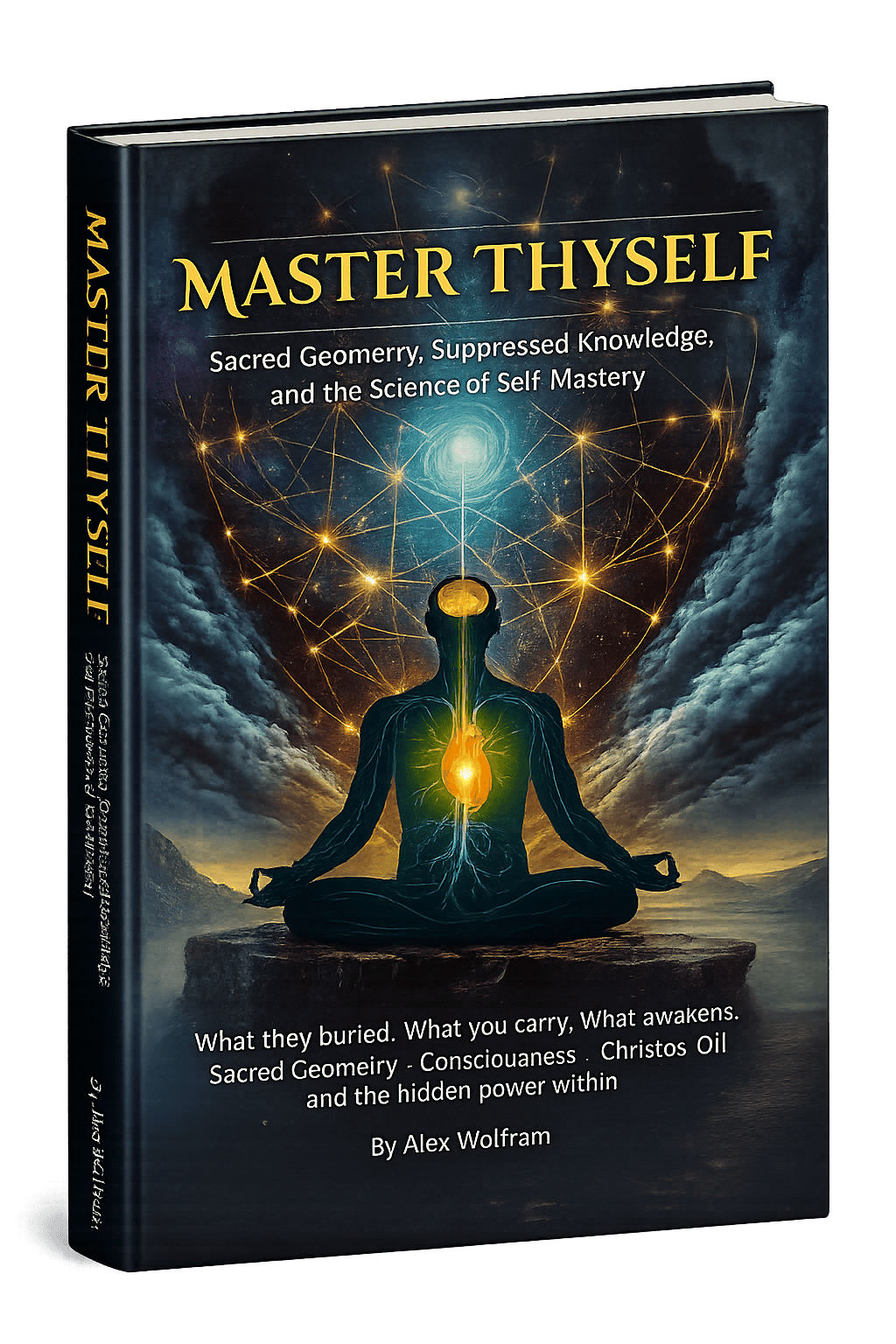
The Complete Temple Map
Solomon's Temple, the Greek Temple, the Gothic Cathedral, and Angkor Wat -- all decoded as maps of the human body. 700+ pages. 30 years of research.
ISBN 979-8-234-07137-8 · Wolfram Management LLC
Still here? Keep pulling.
Each of these threads is traced to its source in the full investigation.
What if …