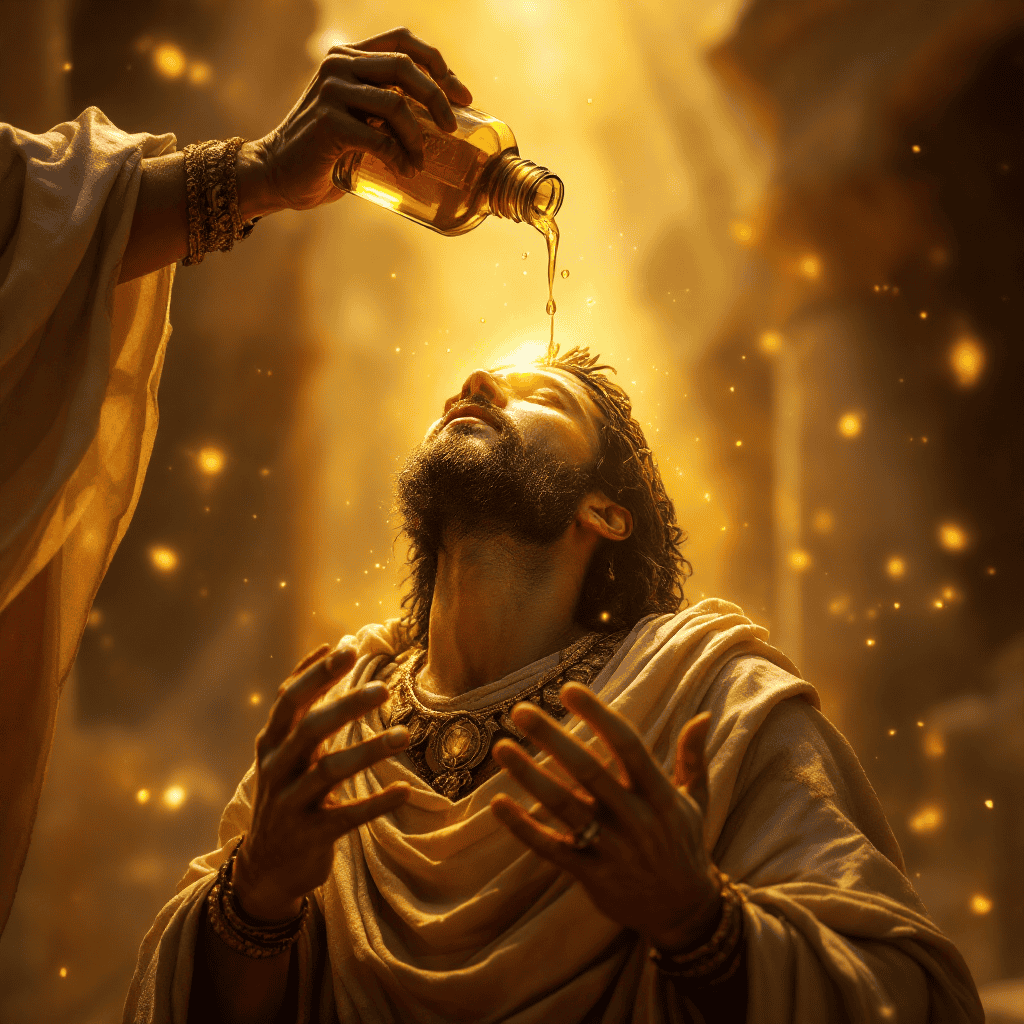
The biblical meaning of christos is “anointed one,” derived from the Greek verb chrio, meaning to anoint with oil. This sacred title, transliterated into English as Christ, was never intended as a surname but as a description of a spiritual state achieved through an inner anointing process. In ancient Hebrew tradition, kings, priests, and prophets were consecrated through the ritual pouring of oil upon the head, symbolizing divine commissioning and alignment with God’s will. The Greek-speaking authors of the New Testament carried this same concept forward, calling Jesus the Christos because he embodied the fullest expression of this anointed state. Yet the original meaning points to something far more intimate than external ceremony: a biological and spiritual transformation accessible to all who walk the path of purification and inner ascent.
The Greek and Hebrew Roots of Christos
In biblical Greek, the word christos (Χριστός) translates the Hebrew mashiach, meaning messiah or anointed. Both terms share the same core meaning: one who has been anointed with sacred oil. In the Old Testament, anointing was a tangible act performed with olive oil mixed with spices, marking an individual for divine service. Kings like David and Saul were anointed by prophets, priests were anointed before serving in the temple, and prophets themselves carried the anointing as a sign of God’s Spirit resting upon them. The physical oil served as an outward sign of an inward reality: the person was set apart, consecrated, empowered for their calling.
When the New Testament writers called Jesus the Christ, they were declaring him the ultimate fulfillment of this pattern. He was the Anointed One, not because oil was poured upon his head by human hands at his coronation, but because the Spirit of God descended upon him at his baptism, as recorded in all four gospels. The dove descending at the Jordan River was the visible sign of an invisible anointing, the moment when divine consciousness and human vessel aligned in perfect coherence. This was not a new phenomenon invented by Christianity. It was the continuation of an ancient tradition preserved across cultures, from Egyptian temple rites to yogic practices, all pointing to the same biological architecture of awakening.
Christos as Title, Not Name
One of the most persistent misunderstandings in modern Christianity is treating Christ as a last name, as if Jesus Christ were simply a person’s given and family name. The biblical meaning of christos reveals something far more dynamic. It was a title describing a state of being, a level of consciousness, an alignment with divine purpose. To be christos was to be anointed, consecrated, and operating as a clear channel for divine will. This is why Paul could write “Christ in you, the hope of glory” in Colossians 1:27. He was not describing Jesus as a person living inside believers, but the Christos state, the inner anointing that could awaken within any purified vessel.
Early Christian communities understood this distinction more clearly than many modern believers. The anointing was both positional and experiential. Jesus held the title uniquely because he embodied it fully, but the same Spirit that anointed him was promised to all who followed his path. The book of Acts records believers receiving the Holy Spirit with visible manifestations, fire descending upon the crown of each person at Pentecost, echoing the anointing ceremonies of the Old Testament. This was not metaphor. It was physiology meeting pneumatology, the sacred secretion rising within the body-temple as practitioners aligned thought, breath, and discipline according to principles explored throughout the Christos Oil tradition.
The Sacred Oil in Ancient Anointing Rites
The oil used in biblical anointing ceremonies was not arbitrary. Exodus 30:22-33 provides the exact recipe for the holy anointing oil used in the tabernacle: myrrh, cinnamon, calamus, cassia, and olive oil, blended in specific proportions. This sacred chrism was so consecrated that using it for common purposes was forbidden under penalty of being cut off from the people. The oil carried symbolic weight as the vehicle of the Spirit, the substance that marked the transition from ordinary to holy, from common to consecrated. When poured upon the head, it ran down the beard and onto the garments, as described in Psalm 133, symbolizing the overflow of divine blessing from the head, the seat of consciousness, down through the entire being.
What most readers miss is that the external oil was always pointing to an internal reality. The human body produces its own sacred secretion, a biochemical anointing generated within the brain and carried through the cerebrospinal fluid along the spinal column. Ancient initiates across Egypt, India, and the mystery schools of Greece understood this process, encoded it into their rites, and taught that the true anointing occurred when this inner oil ascended from the base of the spine to the crown, illuminating the pineal gland and flooding the body with divine awareness. The outer ceremony preserved the memory of the inner mechanism, ensuring that even when the esoteric knowledge was suppressed, the symbol survived.
Jesus as the Embodiment of the Anointed State
Jesus embodied the fullest expression of what christos means. His baptism by John in the Jordan marked the beginning of his public ministry, the moment when heaven opened and the Spirit descended. This was his anointing, visible to witnesses, confirming his identity as the one consecrated for the work ahead. Yet his life demonstrates that anointing is not a single event but a sustained state. He withdrew regularly into solitude, fasted for forty days in the wilderness, maintained purity of thought and action, and repeatedly directed his followers toward the same inner path. When he said “the kingdom of God is within you” in Luke 17:21, he was not offering comfort. He was giving anatomical instruction.
The title christos applied to Jesus because he walked the full curriculum of inner ascent. His crucifixion at age 33 encodes the same number as the vertebrae of the human spine, the rungs of the ladder the sacred oil must climb. His resurrection after three days mirrors the biological cycle of fasting, cellular renewal, and the awakening of dormant faculties when the vessel is purified. The gospel writers were not only recording history. They were encoding a map, using the life of Jesus as the template for what every human body is designed to achieve. The path he demonstrated is the path the physiology was built to walk, and the complete mechanism of how the inner anointing rises through disciplined practice remains one of the most closely guarded teachings in the mystery tradition.
The Anointing in the Early Church
The early church preserved the understanding of christos as an experiential reality, not merely a doctrinal label. Baptism was understood as the initiation into the path, confirmation as the sealing of the anointing, and the laying on of hands as the transmission of the Spirit from one vessel to another. The sacrament of chrismation, still practiced in Orthodox Christianity, involves anointing the newly baptized with consecrated oil on the forehead, eyes, ears, nostrils, mouth, chest, hands, and feet, marking each sense and faculty as dedicated to God. This ritual mirrors the awakening of the energy centers described in Eastern traditions, each gate purified and aligned as the seeker ascends toward union with the divine.
Over centuries, the church externalized what was originally internal. The chrism oil in the vial replaced the sacred secretion in the body. The bishop’s authority to anoint replaced the individual’s responsibility to purify the vessel. The ceremony became the event, rather than the ceremony pointing to the event that should occur within. Yet the symbolism remained intact, preserved in liturgy and iconography, waiting for those with eyes to see. The halo depicted above the heads of saints in Christian art is not decoration. It represents the visible radiance of a fully activated crown, the overflow of the inner anointing when pineal and pituitary glands unite in coherent rhythm, a phenomenon also encoded in the sacred geometry traditions atthe intersection of consciousness and structure.
The Inner Anointing and the Body-Temple
Paul’s declaration in 1 Corinthians 3:16, “Know ye not that ye are the temple of God, and that the Spirit of God dwelleth in you,” is a direct pointer to the inner christos. The temple is not a building in Jerusalem. It is the human body, with the spine as its central pillar, the brain as its holy of holies, and the sacred secretion as the oil that consecrates from within. When this secretion is preserved through fasting, breath control, sexual restraint, and the purification of thought, it ascends the vertebral column, crosses the optic chiasm in the brain, rests in the thalamus for a period of incubation, and rises to activate the pineal gland. This is the resurrection encoded in scripture, the inner Easter that occurs when the vessel is prepared and the timing aligns with the body’s own lunar rhythm.
The biblical meaning of christos becomes fully operational only when this process is understood as biological reality, not religious metaphor. The anointing is real. The oil is real. The transformation is measurable in heart rate variability, brainwave coherence, hormonal balance, and the subjective experience of expanded awareness. Ancient practitioners did not need laboratories to confirm what they could feel and see. The heat rising along the spine, the pressure at the crown, the inner light behind closed eyelids, the spontaneous tears of gratitude, all these signs have been reported across every tradition that preserved the teaching. What Christianity calls being born again, Hinduism calls kundalini awakening, and Taoism calls the circulation of the inner elixir. Different languages, same physiology.
The Seal of the Anointing
Revelation speaks of 144,000 sealed in the forehead, a number that decodes as 12 tribes times 12 apostles times 1000, the mathematical signature of complete coherence. The seal is not a mark imposed from outside but the activation of the twelve cranial nerves, the biological gates through which perception flows. When these gates harmonize, when thought and emotion align, when the heart’s electromagnetic field stabilizes into coherent rhythm, the forehead is sealed not with ink but with light. This is the crown of the christos, the completion of the inner anointing, the moment when the individual vessel becomes a clear channel for divine consciousness. Every mystical tradition describes this threshold, and every control system has worked to obscure it, because an anointed population is an ungovernable population.
The biblical meaning of christos was never meant to be locked inside a single person or a single moment in history. It is a pattern, a blueprint, a biological process encoded into every human body since the design was first laid down. Jesus demonstrated it. The apostles transmitted it. The early mystics practiced it. The institutions externalized it, formalized it, and in many cases buried it beneath ritual and doctrine. Yet the body remembers. The spine still has 33 vertebrae. The pineal still responds to darkness and discipline. The cerebrospinal fluid still circulates with every breath. The architecture of awakening was never dismantled. It was only forgotten, and the timing and discipline required to activate it remains the threshold between information and transformation.
Christos and the Beatitudes
The Sermon on the Mount, particularly the Beatitudes, functions as a ladder of inner ascent directly tied to the christos state. Each blessing describes a stage of purification required for the anointing to rise. “Blessed are the pure in heart, for they shall see God” is not moral instruction alone. It is physiological preparation. The heart generates the strongest electromagnetic field in the body, and when its rhythm stabilizes through gratitude, compassion, and forgiveness, it creates the coherence necessary for the higher centers to activate. “If thine eye be single, thy whole body shall be full of light” is a direct reference to the pineal gland, the single eye at the center of the brain that illuminates when the anointing completes its ascent. These teachings were never abstract ethics. They were the operating manual for the body-temple, preserved in plain language for those ready to see.
The Suppression of the Inner Christos
The biblical meaning of christos carried too much power to be left in the hands of ordinary believers. An anointed individual requires no priest, no ritual, no external validation. They become a direct channel to the divine, self-governing and spiritually sovereign. This posed an existential threat to hierarchical systems built on mediation and control. Over centuries, the church systematically externalized the anointing, moved it from the individual’s body to the bishop’s hand, from the inner secretion to the vial of chrism oil, from experiential gnosis to doctrinal belief. Gnostic texts that preserved the inner teaching were burned. Mystics who spoke of the christ within were labeled heretics. The serpent, ancient symbol of the rising kundalini and the inner anointing current, was recastas Satan, ensuring that seekers would fear the very mechanism designed to liberate them.
Yet suppression is not erasure. The truth survived in symbol, encoded into scripture, stained glass, and the architecture of cathedrals themselves. The cross is not only the instrument of crucifixion but the map of the optic chiasm, the X-shaped crossing inside the brain where the sacred oil is held and transfigured before rising. The crown of thorns is the pressure and heat initiates report when the crown chakra opens. The tomb is the thalamus, the inner chamber where the oil rests in darkness before resurrection. Every detail of the passion narrative encodes a stage of the inner process, and the biblical meaning of christos reveals itself fully only when the text is read as both history and manual, both testimony and instruction.
Living as the Anointed
To embody the christos is to live as a consecrated vessel, aligned with divine purpose, disciplined in thought and action, awake to the presence of God within. It is not a title to claim but a state to cultivate through daily practice. Fasting purifies the vessel. Breath regulates the current. Meditation stills the noise that scatters attention. Prayer aligns intention with the highest good. Service dissolves the ego’s grip. Forgiveness clears the heart’s field. Gratitude stabilizes coherence. Each practice is a note in the symphony that allows the inner anointing to rise without obstruction. The path is not hidden. It is simply demanding, requiring the death of the false self so the true self can emerge anointed and illumined.
The biblical meaning of christos, understood in its fullness, is the revelation that divinity is not distant but encoded in the design of every human being. The anointing is not reserved for prophets and kings. It is the birthright of all who are willing to forsake distortion, purify the temple, and walk the narrow path of inner ascent. Jesus was called the Christ because he completed the journey. But he never claimed to be the only one capable of it. His words were clear: “Greater works than these shall you do.” The anointing he carried is the same anointing available to every seeker willing to discipline the body, quiet the mind, and open the heart. The oil is within. The temple is within. The kingdom is within. And the path to all three has been preserved in the very word that names it: christos, the anointed one, the illumined vessel, the human being made whole.