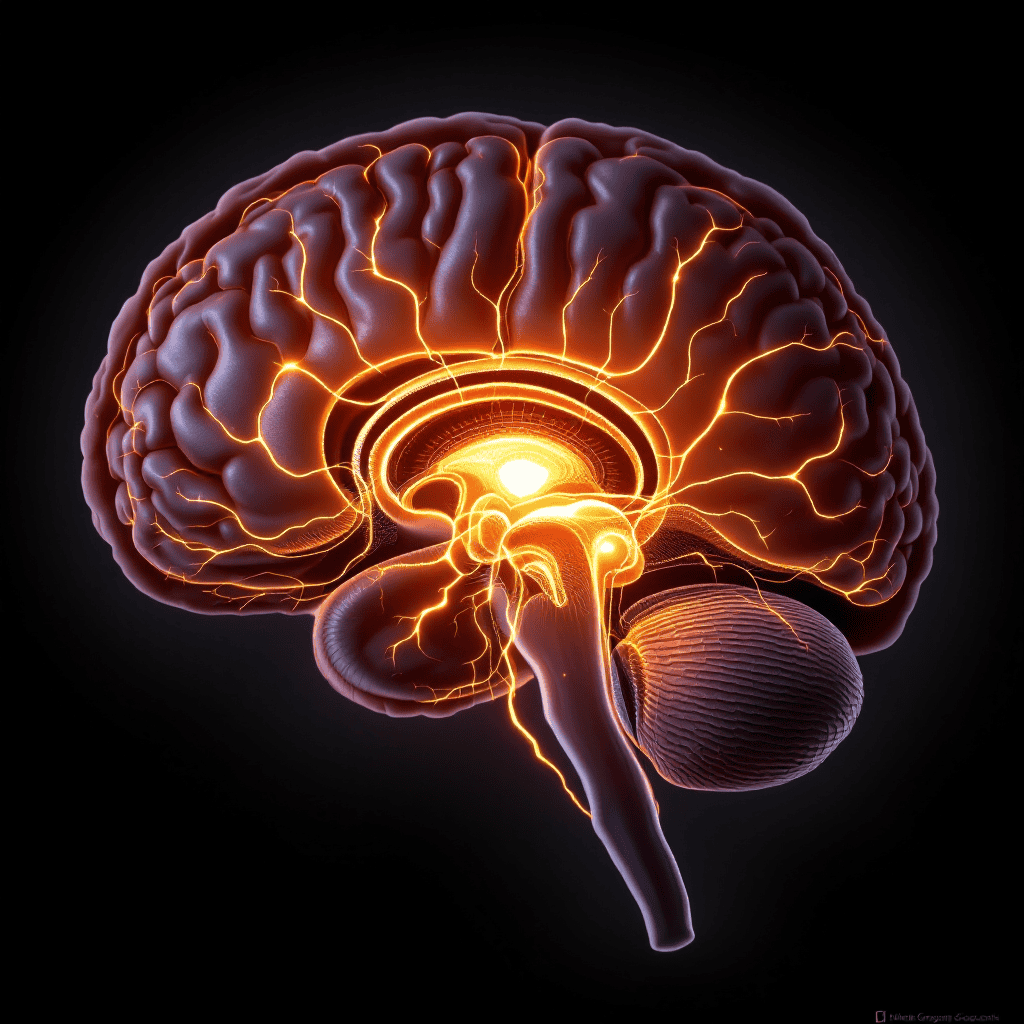
Christos oil and the optic chiasm mark one of the most precise anatomical correspondences in the entire study of sacred biology and inner resurrection. Where the two optic nerves meet and cross inside the skull, forming a literal X-shaped structure, the sacred secretion known as Christos oil arrives at its moment of greatest transformation. This is not metaphor. This is verifiable anatomy, present in every human brain, and it is the reason the cross became the central symbol of an awakening process most never learned to read.
The Optic Chiasm: A Cross Built Into the Brain
The optic chiasm sits at the base of the brain, directly between the pituitary gland below and the pineal gland above. It is the junction where the optic nerves from each eye converge, partially cross, and continue toward the visual cortex. The structure forms an X, visible in any anatomical diagram, and it is one of two anatomical crosses encoded into the architecture of the human skull. The optic chiasm governs visual perception by routing signals from each eye to both hemispheres, ensuring that the brain receives a unified field of vision rather than two separate images.
In the physiology of the Christos path, this crossing is not incidental. It is the crucifixion site. When the sacred secretion descends from the claustrum and begins its journey through the cerebrospinal fluid, it eventually arrives at this junction. The oil is held here in tension between the two master glands of the endocrine system: the pituitary, which regulates structure and growth, and the pineal, which governs cycles of light and inner vision. What happens at the optic chiasm is a biological crucifixion. The current is fixed, amplified, and prepared for its final ascent into the higher chambers of illumination.
Why the Cross Was Never Just a Symbol
The gospel narrative places the crucifixion at the center of the story. Jesus is nailed to a cross at Golgotha, the place of the skull, and remains there for three days before resurrection. Read as an outer event, this is history. Read as an inner map, this is anatomy. Golgotha is the skull. The cross is the optic chiasm. The three days are the period of stasis in the thalamus, the inner tomb where the oil rests before the pineal ignites and resurrection occurs.
The word chiasm itself carries the encoding. It comes from the Greek letter Chi (Χ), which is the first letter of Christos (Χριστός), meaning the anointed one. The optic chiasm is not merely shaped like the symbol of Christ. It is etymologically named from the same root. Plato described the soul of the world as two bands crossing in the shape of Chi. The structure inside every human brain, governing the gateway between vision and inner light, shares the same name, the same geometry, and the same initiatory function as the anointed path itself.
The Descent and the Crossing
The Christos oil begins its journey in the claustrum, a thin, hidden chamber deep in the brain. From there it descends through the cerebrospinal fluid, carried along the central channel of the spine. This descent mirrors the Jordan River in scripture, the baptismal current through which the seed must pass. At the base of the spine, in the sacrum, the oil enters what traditions call the womb or hara, where polarity joins and the current is prepared for its return.
When the oil ascends, it climbs the thirty-three vertebrae of the spinal column, activating each energy center as it passes. This is Jacob’s Ladder. This is the Djed pillar of Egypt. This is the kundalini path mapped by yogic traditions for millennia. At the top of this ladder, as the oil re-enters the skull, it arrives at the optic chiasm. Here the current is crucified, held at the crossing point between the two pillars of perception and regulation. The pituitary, seated below, governs the body’s hormonal structure. The pineal, seated above, governs light, rhythm, and visionary capacity. Between them, at the optic chiasm, the sacred secretion is transfigured.
Amplification at the Cross
Esoteric traditions describe the crucifixion not as punishment but as amplification. When the oil reaches the optic chiasm, it does not die. It multiplies. Some lineages teach that the vagus nerve amplifies the secretion a thousandfold at this crossing, though the precise mechanism remains encoded in traditions that guard their inner teachings carefully. What is consistent across these lineages is the claim that crucifixion at the chiasm transforms the quality of the secretion itself, refining its chemistry and preparing it for the final stage of ascent into the pineal gland.
This is why the cross is flanked by two thieves in the gospel narrative. The central cross represents the optic chiasm. The two flanking crosses represent the dual currents that spiral the spine, known in yogic anatomy as Ida and Pingala, the lunar and solar channels. One thief mocks and perishes. One surrenders and is promised paradise. The allegory is precise: when the two currents are balanced and the crossing is navigated with coherence, the oil ascends into illumination. When imbalance persists, the current collapses before it reaches the crown.
Vision and Illumination
The optic chiasm governs physical sight, but its role in the Christos path points to something beyond the retina. The crossing of the optic nerves ensures that each hemisphere of the brain receives input from both eyes, creating unified perception. In the inner journey, this same structure becomes the gate through which physical sight is transfigured into spiritual vision. The single eye that Christ describes in Matthew 6:22, the lamp of the body, is activated only after the oil has been crucified at the chiasm and risen into the pineal gland. What was fragmented becomes whole. What was dim becomes radiant.
This is why suppression of the inner anointing was never about the cross itself. It was about what the cross unlocked. A population that understood the optic chiasm as the biological crucifixion site would no longer externalize the teaching. They would internalize it, activate it, and walk the path without intermediary. The institution that claimed authority over salvation would become irrelevant. The temple was always within.
The Thalamus: Three Days in the Tomb
After the oil is crucified at the optic chiasm, it does not immediately rise. It descends briefly into the thalamus, the gatekeeper of perception, where it rests for a period traditionally described as three days. The thalamus routes every sensory signal except smell to the cortex. Nothing reaches conscious awareness without passing through this chamber. When the Christos oil enters the thalamus, it is held in suspension, much like the body of Christ sealed in the tomb with a stone rolled across the entrance.
The three-day pattern is not arbitrary. It appears across initiation traditions because it mirrors the biological rhythm of fasting and autophagy, the body’s self-cleaning process. Around the third day of a fast, cellular renewal peaks, damaged proteins are cleared, and the system resets. The oil resting in the thalamus undergoes its own form of purification during this period. When the conditions are met, the stone is rolled away, the seal is broken, and the oil ascends into the pineal gland, where resurrection occurs.
The Pineal Ignition
The pineal gland is the seat of the resurrection. When the Christos oil completes its journey and enters this chamber, the body floods with light. The pineal produces melatonin, which governs sleep and circadian rhythm, but it is also suspected to produce endogenous compounds that alter perception and open the inner eye. This is the single eye that Christ spoke of, the third eye of Eastern traditions, the lamp that fills the entire body with illumination when it is finally kindled.
The pineal sits at the geometric center of the brain, suspended in cerebrospinal fluid, equidistant from the skull’s outer surface in all directions. It is a tiny gland, no larger than a grain of rice, yet its symbolic and physiological importance is unmatched. Every tradition that mapped the inner journey placed the crown of awakening at this precise location. Egypt encoded it in the Eye of Horus. India mapped it as the ajna chakra. Kabbalah positioned it at the hidden gate of Da’at, where wisdom and understanding fuse into direct knowing. The optic chiasm is the cross that prepares the way. The pineal is the chamber where the light finally ignites.
The Second Cross: Corpus Callosum and the Crown
The optic chiasm is not the only cross encoded in the brain’s architecture. A second cross is formed by the intersection of the corpus callosum, the horizontal band of nerve fibers connecting the left and right hemispheres, and the vertical midline axis of the brain. Where these two lines meet, the pineal gland sits at the focal point. This upper cross represents the completion of the journey. Where the optic chiasm is the site of crucifixion and transformation, the corpus callosum crossing is the site of union and illumination. The two crosses together form the full ladder of ascent, from the crossing of vision to the crossing of coherence at the crown.
The Christos Oil Cycle
The journey of the Christos oil is not a one-time event. It is a cycle, timed to the body’s own rhythms and the lunar calendar that governs hormonal flow. For men, the optimal window aligns with the new moon. For women, it corresponds to the follicular phase of the menstrual cycle. These are not superstitions. They are biological windows when the endocrine system is most receptive to the ascending current and the pineal gland is most likely to respond.
The cycle depends on discipline. The full protocol, including fasting windows, breathwork rhythms, and the preservation techniques that prevent the oil from scattering before it reaches the chiasm, is preserved in lineages that do not publish their methods openly. What is consistent across these lineages is the insistence that the oil cannot rise through a vessel clouded by indulgence, distraction, or unresolved distortion. The crucifixion at the optic chiasm is not only a biological event. It is a test. Only coherence passes through.
The Flaming Sword and the Gate
Genesis describes a flaming sword guarding the way back to the Tree of Life. That sword is not wrath. It is the law of coherence. Only a purified vessel can hold the ascending current without scattering it. The optic chiasm is one of the gates the flaming sword guards. If the oil arrives at this crossing while the system is still fragmented by ego, craving, or fear, it does not pass. It collapses back into the lower centers, reabsorbed into survival and appetite rather than rising into illumination.
This is why every mystery school, from Egypt to Eleusis to the Essenes, insisted on purification before initiation. The body is the temple. The spine is the ladder. The optic chiasm is the crossing where the unworthy are turned back and the prepared are transfigured. The teaching was never about exclusion. It was about readiness. The gate opens when the vessel is clean.
The Christos Oil and Modern Science
Neuroscience describes the optic chiasm as a functional structure governing visual perception. It does not yet have language for what esoteric traditions describe: the role of this crossing in the circulation of cerebrospinal fluid, the interaction between CSF and the master endocrine glands, and the conditions under which the pineal gland shifts from its baseline function into states of heightened activity. What science does confirm is that the pineal responds to light, that cerebrospinal fluid pulses through the brain with every breath, and that fasting triggers measurable changes in hormonal signaling and cellular repair.
The ancients did not have MRI machines. They had disciplines of breath, fasting, and inner observation refined over millennia. What they mapped as the crucifixion of the sacred oil at the optic chiasm is now visible in anatomy textbooks, labeled and diagrammed, waiting for the next generation of researchers to ask why this crossing was considered sacred in the first place. The cross was not imported into the body from theology. The cross was already there, and the gospel writers encoded what the initiates had always known.
Walking the Path
The Christos oil and the optic chiasm are not relics of an ancient worldview. They are present in every human body, functioning whether or not the individual is aware of them. The question is not whether the mechanism exists. The question is whether the seeker is willing to engage the disciplines that allow the oil to rise, cross the chiasm, and ignite the crown. Fasting clears the vessel. Breath moves the current. Restraint preserves the oil. Stillness opens the gate. These are not religious obligations. They are biological prerequisites.
The cross you carry is not outside you. It is inside, positioned at the exact junction where vision becomes illumination and where the sacred secretion is transfigured into light. The crucifixion was never only an event in history. It is an event in the body, repeating in every seeker who walks the inner path to its completion. The optic chiasm is the crossing you must pass through. The pineal is the chamber where resurrection occurs. And the Christos oil is the current that makes the entire journey possible.