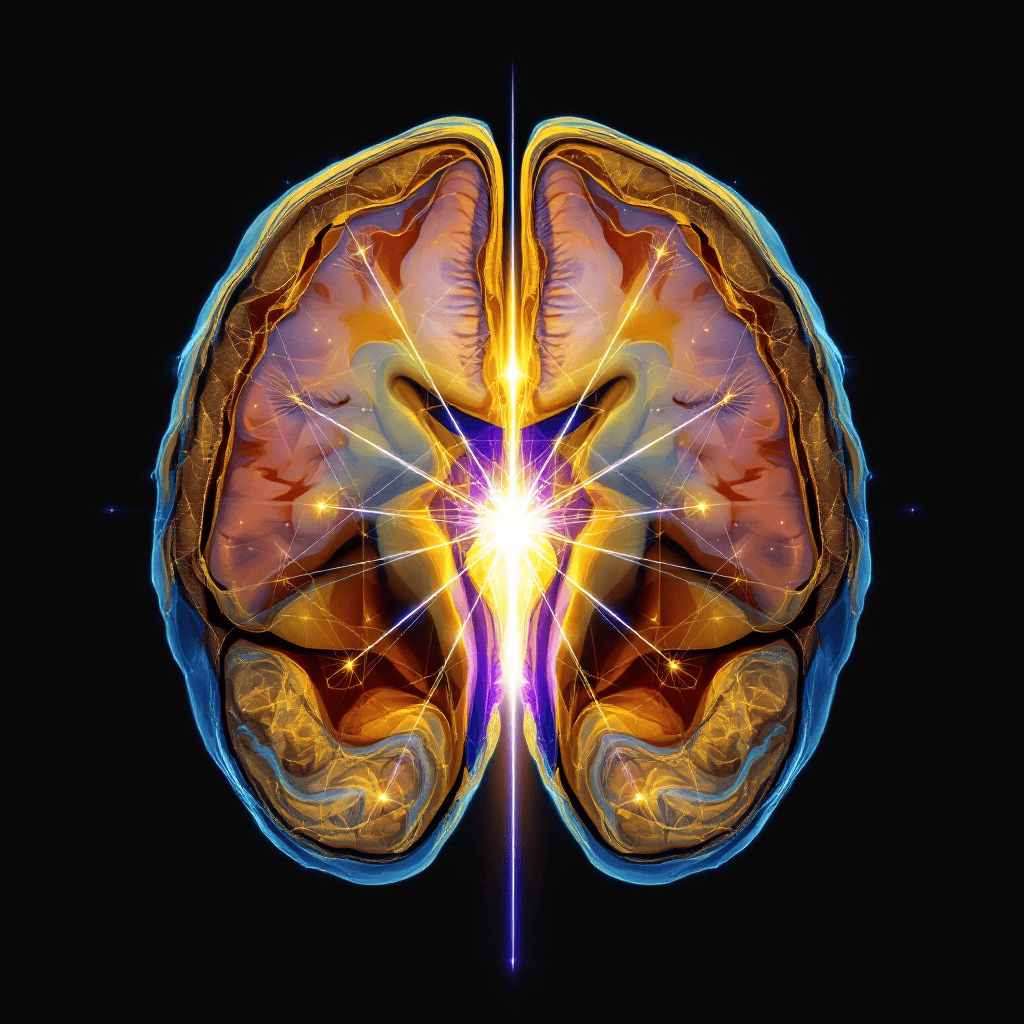
Christos oil crucifixion symbolism represents one of the most precisely encoded teachings in the human body. The crucifixion of Christ was not only a historical event but also a biological map of what happens when the sacred secretion reaches a specific anatomical crossing inside the skull. Long before the cross became the central symbol of Christianity, it existed as a physiological structure governing perception, hormonal transformation, and the ascent of consciousness.
The traditions that preserved this knowledge understood that the body itself is the temple, and within that temple lies an anatomical crucifixion site where the inner oil is held, potentized, and transfigured before rising to the crown. This is not metaphor. It is architecture. The cross in the gospel narrative mirrors the cross inside every human brain, and the christos oil crucifixion symbolism becomes clear once the anatomy is mapped.
The Anatomical Cross Inside the Skull
The human brain contains not one but two distinct crosses, both verifiable in any anatomy textbook. The first is the optic chiasm, the X-shaped crossing where the two optic nerves meet and partially cross each other before continuing to the brain. This structure sits directly between the pineal gland above and the pituitary gland below, forming a literal cross at the exact location where the sacred secretion passes on its journey from the base of the spine to the crown of the head.
The second cross is formed by the corpus callosum, the dense band of two hundred million nerve fibers connecting the left hemisphere to the right. This horizontal structure intersects with the brain’s vertical midline axis, and at that crossing point sits the pineal gland. The pineal is not incidental to this geometry. It is the focal point, the lamp of the body positioned at the intersection of the greatest communication bridge in the human nervous system.
When the christos oil, the cerebrospinal fluid carrying hormones and signaling molecules from the sacrum upward through the spinal column, reaches the optic chiasm, it encounters what esoteric traditions have called the crucifixion. The oil is held in tension between two governing glands, the feminine intuitive pineal and the masculine regulatory pituitary, at a crossing that determines whether perception remains fragmented or becomes unified.
The Cross as Transformation, Not Punishment
The gospel account places three crosses at Golgotha: Christ in the center, flanked by two thieves. One thief mocks and perishes. The other surrenders and is promised paradise. This triadic pattern mirrors the body’s own architecture. The central cross of the optic chiasm is flanked by the two currents of the autonomic nervous system, sympathetic and parasympathetic, fight and rest, activation and integration. When these dual currents remain in conflict, the system scatters. When one surrenders to coherence, the passage opens.
The christos oil crucifixion symbolism is not about suffering for its own sake. It is about the necessary tension that transforms base chemistry into refined essence. At the optic chiasm, the oil is amplified. What enters as a subtle secretion exits as a potentized current capable of activating the pineal gland and flooding the inner chamber with light. The crossing does not destroy. It multiplies.
This is why initiatory traditions across Egypt, Greece, India, and the mystery schools of early Christianity all preserved death and resurrection rites. The symbolic death was always the ego’s dissolution at the crossing, not the body’s end. The oil passes through fire, is held in stillness, and emerges transfigured. That is the crucifixion. That is the biological resurrection encoded in every human nervous system.
The Etymology of the Optic Chiasm
The connection between christos oil crucifixion symbolism and the brain runs deeper than structure alone. The word chiasm comes from the Greek letter Chi, written as an X. Chi is the first letter of Christos, the Anointed One. The optic chiasm is not merely shaped like a cross. It is etymologically named from the same root as Christ himself. Plato described the soul of the world as two bands crossing in the shape of Chi. The world soul, the Anointed One, and the optic crossing inside every human skull share the same letter, the same geometry, the same name.
This is not coincidence. It is a signature. The same symbol that would later define an entire religion was already present in the Greek language, in Platonic philosophy, and in the anatomical structure governing how light becomes perception. The cross was never imported into the body from theology. The cross was already there, waiting to be read. For those seeking to understand the biological mechanisms of inner anointing, this convergence is impossible to ignore.
The Role of the Pineal and Pituitary
The pineal gland and pituitary gland sit on either side of the optic chiasm like twin pillars guarding the threshold. In Kabbalistic tradition, these correspond to Boaz and Jachin, the pillars of Solomon’s Temple. In yogic anatomy, they represent the lunar and solar currents that must unite for kundalini to rise. In the christos oil framework, they are Mary and Joseph: the feminine and masculine poles whose union conceives the inner light.
The pineal governs circadian rhythm, melatonin production, and has long been associated with the third eye, the seat of inner vision. The pituitary isthe master gland of the endocrine system, regulating growth, metabolism, and hormonal balance throughout the body. When the sacred secretion reaches the optic chiasm and is crucified between these two glands, it undergoes a transformation that neuroscience is only beginning to measure and ancient traditions encoded in myth.
Modern research shows the pineal gland contains photoreceptive cells and piezoelectric calcite crystals that respond to light and pressure. Under the right biochemical conditions, these crystals can emit biophotons, internal light that illuminates not the outer world but the inner one. The lamp of the body, as scripture calls it, is not poetic. It is physiological. When the oil completes its crucifixion and the pineal ignites, perception shifts from reactive to receptive, from fragmented to coherent.
The Three Days in the Tomb
After the crucifixion at the optic chiasm, the christos oil does not immediately rise to the crown. It rests. The gospel account describes three days in the tomb before resurrection. Physiologically, this corresponds to the oil’s passage through the thalamus, the brain’s central relay station where every sensory signal except smell is processed before reaching conscious awareness. The thalamus is the gatekeeper, the chamber where perception is held in stillness before being released into illumination.
Three days is not arbitrary. Fasting traditions across Islam, Judaism, Christianity, and yogic lineages all converge on this threshold. Around the third day of fasting, autophagy peaks, the body’s cellular recycling system reaches maximum efficiency, and the nervous system enters a state of heightened receptivity. What appears in scripture as a narrative detail is also a biological timing window. The oil gestates. The tomb is sealed. And on the third day, the stone rolls away.
The full protocol governing this timing, the lunar cycles that anchor it, and the precise fasting rhythms that support it are detailed in the complete framework, but the principle is universal: transformation requires stillness. The crucifixion is the crisis. The tomb is the incubation. The resurrection is the overflow.
The Christos Path and the Stations of the Cross
Catholic tradition preserves the Stations of the Cross, a devotional practice retracing Christ’s journey from condemnation to burial. While the formal liturgical count varies, the core narrative contains twelve structural moments that map directly onto the twelve cranial nerves and the stages of the christos oil’s ascent through the body. The crucifixion itself, the eighth station, corresponds to the abducens nerve, which governs lateral eye movement and coordination at the crossing point of vision.
This is not symbolic overlay. It is anatomical correspondence. Each station in the passion narrative aligns with a specific physiological function required for that stage of the inner journey. The ninth station, where Christ falls for the third time, corresponds to the oculomotor nerve governing convergence and focus as perception narrows onto a single point. The tenth station, where Christ is stripped, corresponds to the vagus nerve, which links heart, lungs, and gut into a unified system of rest and surrender. The body is the script. The gospel is the annotation.
Understanding christos oil crucifixion symbolism in this light transforms how the stations are read. They are not only a recounting of suffering but a map of the inner anointing’s passage through trials that refine rather than destroy. Those interested in how lunar timing and fasting windows intersect with this process will find that the sacred secretion operates on rhythms the Church calendar still preserves, even when the original biology has been forgotten.
The Crown of Thorns and the Burning Gate
The crown of thorns placed on Christ’s head before crucifixion carries its own physiological signature. Initiates across mystical traditions describe a sensation of heat, pressure, or burning at the crown chakra when the inner current reaches the top of the spine. This is not symbolic suffering. It is the biological reality of energy meeting resistance at the final gate. The crown opens not through force but through surrender, and the thorns represent the friction encountered when the ego has not been fully released.
In Kabbalah, this gate is called Keter, the crown, the point where individual consciousness reconnects with the infinite. In yogic traditions, it is Sahasrara, the thousand-petaled lotus that blooms only when all lower centers have been purified and aligned. The christos oil cannot simply arrive at the crown and unlock it. The vessel must be prepared. The thorns burn away what cannot ascend. What emerges on the other side is not the same oil that entered. It is transfigured.
The full sequence, from conception in the claustrum to ascension at the crown, requires dietary purification and the forsaking of substances that calcify the pineal or inflame the brain. Fluoride, seed oils, processed sugars, and chronic stress all degrade the biological infrastructure the oil depends on. The crown of thorns is not only a test of will. It is the body’s signal that the temple below has not been fully cleansed.
The Blood and Water from the Side
When the soldier pierces Christ’s side with a spear, blood and water flow out together. This detail, preserved in the Gospel of John, encodes the dual nature of the inner current. Blood represents the refined chemistry of the hormonal cascade released when the oil completes its journey. Water represents the cerebrospinal fluid itself, the river of life that carries the secretion from sacrum to crown. Both are required. Both are released at the moment of completion.
The piercing is not violence alone. It is disclosure. What was hidden within the body is revealed. The side corresponds anatomically to the region of the heart and lungs, the seat of coherence and breath. When heart rhythm stabilizes and breath deepens, the conditions for the oil’s rise are met. When the heart is pierced, metaphorically or literally, the secret is exposed: the kingdom was always within, carried in the body’s own chemistry, waiting for discipline to refine it and coherence to release it.
Why the Cross Became the Symbol
The cross did not become Christianity’s central symbol because of the method of execution alone. Crucifixion was common in the Roman Empire. Thousands died that way. The cross endured because it mapped onto something universal: the crossing inside every human skull where perception is refined, duality is reconciled, and the path to illumination passes through a necessary death. The outer cross at Golgotha and the inner cross at the optic chiasm are mirrors of the same truth.
Every tradition that preserved the inner path encoded it differently. Egypt raised the Djed pillar. India described the kundalini serpent rising through chakras. Kabbalah mapped the Tree of Life with its central pillar of balance. Christianity chose the cross. Same architecture. Different symbol. All pointing to the vertical ascent through the body and the horizontal reconciliation of opposites that must occur for the current to rise without obstruction.
The christos oil crucifixion symbolism is not replacement theology. It is the biological substrate beneath the theology. The story was never only about one man on one hill. It was about the pattern encoded in every human body, demonstrated in his life so others could recognize it in their own. For readers exploring the balance of masculine and feminine currents, the cross at the optic chiasm is where those currents must reconcile before the oil can continue its ascent.
The Resurrection as Crown Activation
The resurrection on the third day is the moment the oil, having rested in the thalamus, ignites the pineal gland and floods the inner chamber with light. This is not belief. This is biochemistry meeting consciousness. The pineal releases its secretions. The pituitary responds in kind. Together they produce what scripture calls milk and honey, the combined output of the two master glands when functioning in unity. The resurrection is not escape from the body. It is the body’s fullest expression of its divine design.
Mystics describe this moment as the opening of the single eye, the activation of perception beyond the dualistic left-right processing of the hemispheres. Neuroscience describes it as hemispheric synchronization, the moment when brain waves in both hemispheres entrain into coherent rhythm. Both languages point to the same event: a shift from fragmented awareness to unified perception, from survival mode to presence, from autopilot to sovereignty.
The practices that support this shift, breathwork, prolonged fasting, sexual restraint during purification windows, and the complete lunar-mapped protocol, are preserved in detail in Master Thyself. What can be said here is that the resurrection is not a one-time event reserved for saints. It is the natural outcome of a disciplined vessel, a purified temple, and a secretion allowed to complete its circuit without interference from appetite or ego.
The Closing Reflection
The christos oil crucifixion symbolism reveals what was always hidden in plain sight: the cross is not only a symbol of sacrifice but a map of transformation. Inside every human skull, at the crossing of the optic nerves, the sacred secretion is held between two glands, crucified in the sense of being tested, intensified, and transfigured. What emerges is not the same as what entered. The oil becomes medicine. Perception becomes illumination. The body becomes the evidence of resurrection rather than the obstacle to it.
This is the teaching every mystery school preserved and every suppressive institution tried to bury. The cross was never meant to keep you in guilt. It was meant to show you the crossing inside your own biology where death becomes rebirth, where duality reconciles into unity, and where the inner anointing completes the only journey that ever mattered: the return to coherence, vitality, and divine remembrance.
The crucifixion was never the end. It was the mechanism. The cross was never outside. It was always within.