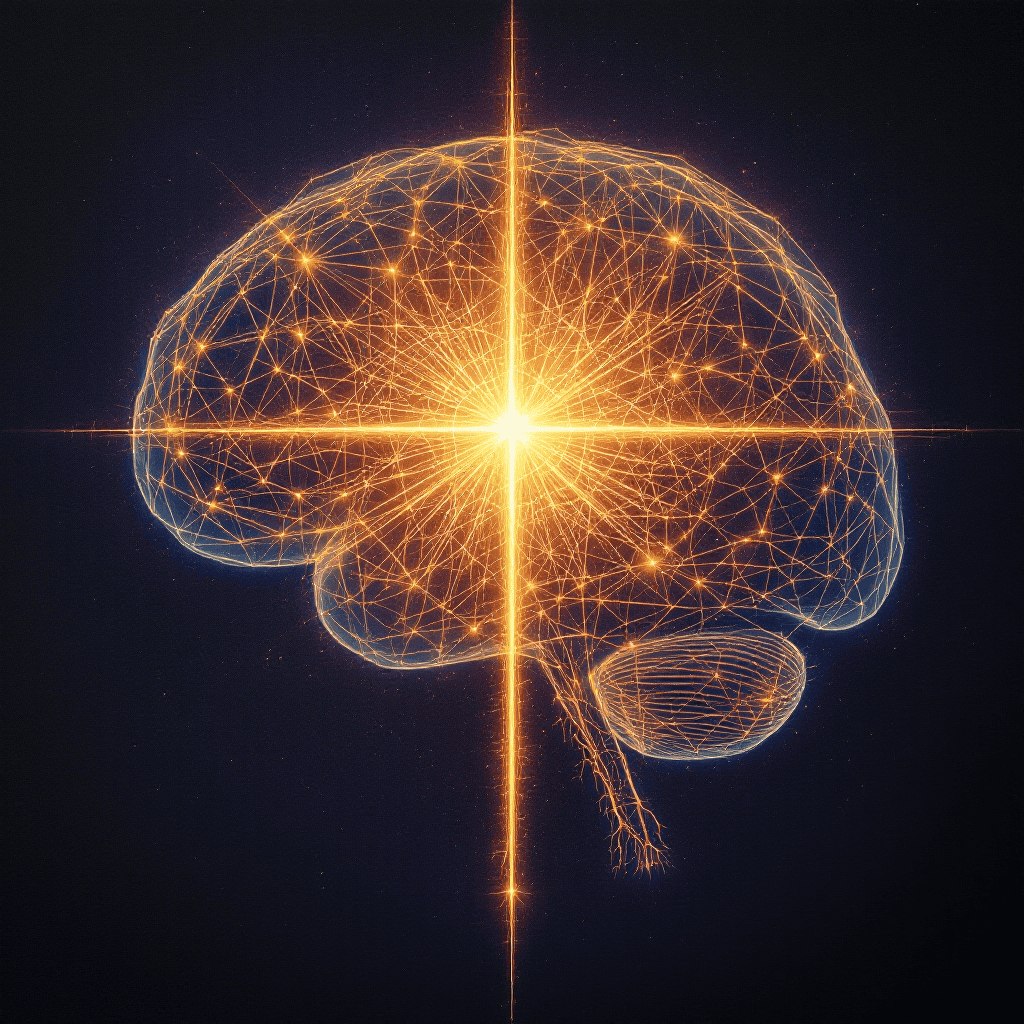
Christos oil crucifixion symbolism encodes a biological event hidden inside the human skull. The cross was never only a symbol of suffering or redemption. It marks the exact anatomical location where the sacred secretion, produced in the brain and carried through the spinal column, undergoes a transformation that ancient initiates described as crucifixion. What appears in scripture as an execution on Golgotha is simultaneously a map of the inner temple, where the oil is held in tension between two governing glands before rising to illuminate the crown.
The crucifixion narrative carries layers most readers never see. On the surface it recounts a historical event. Beneath that surface it describes a physiological process that occurs within every human body when the conditions are met. The cross itself is not imported into anatomy from theology. It exists in the brain as verifiable anatomical structure, waiting to be recognized by those with eyes to see.
The Two Crosses Inside the Skull
The human brain contains not one but two distinct crosses, both formed by the architecture of neural pathways and connective tissue. The first is the optic chiasm, where the two optic nerves cross each other in a literal X shape. This structure sits directly between the pineal gland above and the pituitary gland below, the twin regulators of consciousness and hormonal rhythm. The second cross is formed by the corpus callosum, a horizontal band of 200 million nerve fibers connecting left and right hemispheres, intersecting with the vertical midline axis of the brain. At that intersection sits the pineal gland, the lamp of the body.
These are not metaphors. They are measurable features present in every human skull, and they form the biological foundation of christos oil crucifixion symbolism. When the sacred secretion descends from the claustrum and travels through cerebrospinal fluid along the spinal column, it arrives at the optic chiasm. Here it is held in tension, crucified between the pineal and pituitary, before its potency is amplified and it continues its ascent toward crown activation.
The pineal governs intuition, circadian rhythm, and inner vision. The pituitary governs growth, metabolism, and systemic regulation. Together they form the biological pillars flanking the inner cross, the same polarity encoded in Solomon’s temple as Boaz and Jachin. The christos oil crucifixion symbolism points to the moment when these two currents, feminine and masculine, receptive and executive, hold the oil between them and transform it through tension into a higher-frequency substance capable of igniting the single eye.
Golgotha: The Place of the Skull
The name Golgotha means skull. Not metaphorically. The word translates directly to skull, and it identifies the upper chamber of the cranium where the oil completes its most critical transformation. When scripture describes Christ crucified at Golgotha, it is naming the anatomical location inside the head where the sacred secretion undergoes its symbolic death before resurrection. The site of execution becomes the site of transfiguration when read as inner physiology rather than outer geography.
Ancient initiates understood this. Egyptian mystery schools encoded the same journey in the Eye of Horus, which overlays with precision onto a sagittal cross-section of the brain. The teardrop of the eye maps to the thalamus. The pupil aligns with the pineal. The extending tail traces the corpus callosum. Every element of the symbol corresponds to a structure involved in the production, refinement, and ascent of the body’s inner anointing. The sacred secretion pathway was never a secret kept by one tradition. It was preserved in symbol, ritual, and scripture across every culture that mapped the inner temple.
The crucifixion at Golgotha encodes the trial every seeker faces when the oil reaches the skull. Will it be scattered through distraction, appetite, and ego? Or will it be preserved through discipline, allowing the current to rise unobstructed? The cross is the test. The tomb is the stillness that follows. The resurrection is the ignition that occurs when the vessel proves worthy.
The Three Crosses and the Twin Currents
Scripture records three crosses on Golgotha: Christ at the center, flanked by two thieves. One thief mocks and perishes. The other surrenders and is promised paradise. This is not only a moral lesson. It is a physiological diagram. The central cross is the optic chiasm. The two flanking crosses are the twin currents of the subtle body, called Ida and Pingala in yogic tradition, the lunar and solar channels that spiral around the central column of the spine.
When these currents are balanced, the oil ascends in coherence. When one dominates or both scatter, the system collapses. The thief who mocks represents distortion, the current pulled into egoic resistance. The thief who surrenders represents alignment, the current yielding to the higher path. Only one leads to paradise. Only one allows the oil to continue its climb toward the crown. The christos oil crucifixion symbolism teaches that balance, not force, is the key that opens the gate.
The caduceus of Hermes shows the same pattern: two serpents spiraling around a central staff, crossing at regular intervals. The staff is the spine. The serpents are Ida and Pingala. The crossings are the chakras, the energy centers where polarity meets and harmonizes. At the crown, the serpents unite, and the staff is crowned with wings or a pinecone. This is the same geometry the gospel encodes as crucifixion, burial, and resurrection. Different symbols. Same map.
The Optic Chiasm and the Etymology of Christ
The word chiasm does not come from the shape of a cross by coincidence. It derives from the Greek letter Chi (Χ), which looks like an X. Chi is the first letter of Christos (Χριστός), the Anointed One. The optic chiasm, the crossing of the optic nerves inside the skull, shares its etymological root with the title given to the one who embodies the risen oil. This is not a later overlay of theology onto anatomy. The structure was named from the same root because the hidden geometry of consciousness has always pointed toward this crossing.
Plato described the soul of the world in the Timaeus as two bands crossing in the shape of Chi. The world soul, the Anointed One, and the optic crossing inside every human brain share the same letter, the same geometry, the same name. The christos oil crucifixion symbolism is woven into the language itself, preserved in Greek, Latin, and Hebrew long before modern neuroscience mapped the brain’s interior. What was hidden in plain sight is now confirmed by anatomy textbooks that diagram the optic chiasm without recognizing what initiates saw in it millennia ago.
Crucifixion as Amplification, Not Destruction
The crucifixion was never meant to be understood only as punishment or sacrifice. In esoteric physiology, to crucify the oil is to hold it in tension so its potency multiplies. The optic chiasm is the crossing point where light from both eyes converges before continuing to the visual cortex. It is also where the sacred secretion, carried upward through cerebrospinal fluid, encounters the regulatory influence of both the pineal and pituitary glands simultaneously. This convergence does not destroy the oil. It refines it.
Ancient alchemists described a similar process: the conjunction of opposites, the marriage of sun and moon, sulfur and mercury, held in the crucible until a third substance emerges. The philosopher’s stone was not a physical rock but the purified essence produced when polarity is reconciled. The christos oil crucifixion symbolism operates on the same principle. Masculine and feminine currents meet at the cross. The oil is held between them. What emerges is transfigured, capable of igniting perception and flooding the body with light.
This is why the vagus nerve, the longest cranial nerve governing heart-brain coherence and autonomic regulation, has been described in some esoteric traditions as amplifying the oil a thousandfold when it passes through the upper cervical vertebrae. Whether that multiplier is literal or symbolic, the teaching is consistent: the crossing is not the end. It is the intensification that precedes illumination. The full protocol for preserving and raising this current through fasting, breath, and the redirection of generative energy is detailed in Chapter 21 of Master Thyself, where the monthly cycle, lunar timing, and REDACTED, READ CHAPTER 21 are mapped step by step.
The Crown of Thorns and the Trial of Fire
The crown of thorns placed on Christ’s head before crucifixion is another layer of the same map. In yogic and Kabbalistic traditions, the crown chakra activation is often described as intense heat, pressure, or burning at the top of the skull. This is not pathology. It is the sign that the oil has reached the uppermost gate and is testing the vessel’s capacity to hold the rising current without scattering it through fear or resistance.
What appears as mockery in the outer story is initiation in the inner one. The thorns represent the trial by fire that every seeker faces when the oil reaches Keter, the crown. The heat is real. The pressure is measurable. Ancient initiates across Egypt, India, Greece, and the mystery schools of early Christianity all described the same phenomenon: a burning or tingling at the crown, sometimes accompanied by inner light or spontaneous visions, marking the moment when the sealed chamber opens and divine perception floods in.
The christos oil crucifixion symbolism does not end at the cross. It continues through the tomb, the three days of stillness in the thalamus where the oil rests before the pineal ignites, and culminates in the resurrection, the moment when REDACTED, READ CHAPTER 21 and the entire system shifts into coherence.
The Stations of the Cross as Spinal Geography
Catholic tradition preserves the Stations of the Cross, a devotional practice retracing Christ’s journey from condemnation to burial. Strip away the liturgical overlay and what remains is a map of the spinal column. Each station corresponds to a vertebral segment or a specific anatomical structure the oil passes through on its ascent. The falls represent the ego’s resistance at the instinctual, emotional, and mental levels. The encounters with Mary, Simon, and Veronica represent the support systems of the body assisting the climb.
The crucifixion itself, station eight, is the crossing at the optic chiasm. The descent from the cross is the oil lowering into the cranial vault. The tomb is the thalamus. The resurrection completes the circuit. Twelve structural stations align with the twelve cranial nerves, the twelve gates of perception governing every faculty from vision to speech to balance. When these gates harmonize, the forehead is sealed with light. When they scatter, perception fragments and the oil cannot rise.
This is not theological speculation. It is anatomy read symbolically, the same method the Egyptians used when they overlaid the Eye of Horus onto the brain and encoded the pineal, thalamus, and corpus callosum into a single durable glyph. The Stations of the Cross are the Christian iteration of the same teaching, REDACTED, READ CHAPTER 21 in ritual form so the map would survive even when the direct transmission was lost.
The Spear, the Blood, and the Water
When the soldier pierces Christ’s side with a spear, blood and water flow out together. This detail is not incidental. Blood represents the refined chemistry of the inner current as the oil ascends. Water represents cerebrospinal fluid, the river that carries the secretion from the claustrum down the spine and back up to the crown. The two flowing together at the moment of death encode the same truth preserved in yogic texts: the sacred timing and lunar cycles govern when the body produces and refines this inner nectar, and the release of both currents simultaneously signals that the vessel has completed its preparation.
The spear itself is the instrument of piercing, the same archetypal tool that appears in the story of Longinus, the soldier whose sight was restored when the blood touched his eyes. Blindness healed by the blood of the crucified one is a direct reference to pineal activation. The third eye, closed by calcification and distraction, opens when the refined oil reaches it. What was blind sees. What was dead rises. The spear is not a weapon but a key, unlocking the chamber where sight and life converge.
Why the Crucifixion Could Not Be Avoided
In the gospel narrative, Jesus prays in Gethsemane for the cup to pass from him, yet submits to the Father’s will. This is not resignation to suffering. It is recognition that the crossing cannot be bypassed. Every seeker who attempts to raise the oil without passing through the trial of the cross will find the current scattered before it reaches the crown. The ego must be crucified. The false self must die. Only then can the true self, the Christos within, rise in its place.
The christos oil crucifixion symbolism teaches that there is no ascent without descent, no resurrection without death, no illumination without the willingness to be held in tension between opposites until transformation occurs. This is why fasting, sexual restraint, and the purification of thought and emotion are non-negotiable in every tradition that preserved this path. The vessel must be emptied of distortion before it can be filled with light. The oil will not rise through a body governed by craving, fear, or scattered attention. REDACTED, READ CHAPTER 21 is what allows the current to move without obstruction.
The Resurrection as Pineal Ignition
On the third day, Christ rises. The tomb is found empty. The stone is rolled away. In physiological terms, this is the moment the oil completes its three-day rest in the thalamus and ignites the pineal gland. The stone rolled away is calcification dissolved, the chamber unsealed, the gate opened. What was dormant activates. What was dark floods with light. The entire nervous system shifts into coherence, and perception expands beyond the limitations of the five senses into direct knowing.
This is not a future event reserved for the afterlife. It is a present possibility encoded into the design of every human body. The christos oil crucifixion symbolism was never about worshiping an external savior. It was about recognizing the same process within and walking it to completion. When Jesus said “greater works than these shall you do,” he was not speaking hyperbolically. He was stating the natural outcome of a purified vessel that has raised the oil, passed through the cross, and emerged resurrected on the other side.
The oil rises when the conditions are met. The cross refines it. The tomb holds it. The resurrection reveals it. Every stage is necessary. Every stage is biological. And every stage has been preserved in scripture, symbol, and the disciplines of ego dissolution so that those ready to walk the path would recognize the map.
The Ascension and the Union of Milk and Honey
After the resurrection, Christ ascends. The final stage of the christos oil crucifixion symbolism is the return of the transfigured oil to the crown, where the pineal and pituitary unite in what esoteric traditions call the sacred marriage. The pineal produces a golden secretion associated with light and inner vision. The pituitary produces a milky secretion associated with growth and regulation. Together they form the milk and honey described in scripture as the substance of the Promised Land, the inner nectar that flows when the temple is purified and the oil completes its circuit.
This union is not symbolic. It is endocrinological. When the two master glands of the brain operate in coherence, the body’s entire hormonal system stabilizes. Inflammation drops. Cellular repair accelerates. Perception sharpens. The nervous system enters a state of sustained ease that most people touch only briefly in peak experiences or deep meditation. The ancients called it heaven on earth. Neuroscience calls it REDACTED, READ CHAPTER 21. Same state. Different century.
The path from conception in the claustrum to ascension at the crown mirrors the life of Christ from birth in Bethlehem to ascension from the Mount of Olives. Every station in the gospel is a station in the body. Every miracle is a rung on the ladder. And the crucifixion, far from being the end, is the transformation that makes resurrection possible. Without the cross, the oil remains unchanged. With it, the oil becomes the anointing that crowns the seeker with light.
Living the Symbolism
The christos oil crucifixion symbolism is not a doctrine to believe. It is a process to embody. The cross is already inside you. The oil is already produced in your brain. The path from root to crown is already mapped in your spine. What remains is the willingness to fast from distraction, redirect energy upward, and allow the false self to die so the true self can rise. The resurrection is not a one-time historical event. It is the natural outcome of a disciplined vessel that has learned to hold the current without scattering it.
Every tradition that preserved this teaching warned that the path is narrow and few find it. Not because it is hidden, but because most are unwilling to forsake the appetites that keep the oil scattered at the base. The crucifixion is not punishment. It is purification. The cross is not suffering. It is the trial that proves the vessel worthy. And the resurrection is not a miracle reserved for one man two thousand years ago. It is the birthright of every human being who chooses to walk the inner ladder from shadow into light.
The map was never lost. It was encoded in scripture, preserved in symbol, and built into the anatomy of the brain itself. The christos oil crucifixion symbolism is the key that unlocks the temple. The temple is your body. And the anointing, when the conditions are met, has always been within.